How Much Democracy Can Trillions of Stolen Tax Dollars Buy?
The War On Waste
Defense Department Cannot Account For 25% Of Funds — $2.3 Trillion
January 29, 2002
LOS ANGELES, (CBS) On Sept. 10, Secretary of Defense Donald Rumsfeld declared war. Not on foreign terrorists, "the adversary's closer to home. It's the Pentagon bureaucracy," he said.
He said money wasted by the military poses a serious threat.
"In fact, it could be said it's a matter of life and death," he said.
Rumsfeld promised change but the next day – Sept. 11-- the world changed and in the rush to fund the war on terrorism, the war on waste seems to have been forgotten.
Just last week President Bush announced, "my 2003 budget calls for more than $48 billion in new defense spending."
More money for the Pentagon, CBS News Correspondent Vince Gonzales reports, while its own auditors admit the military cannot account for 25 percent of what it spends.
"According to some estimates we cannot track $2.3 trillion in transactions," Rumsfeld admitted.
$2.3 trillion — that's $8,000 for every man, woman and child in America. To understand how the Pentagon can lose track of trillions, consider the case of one military accountant who tried to find out what happened to a mere $300 million.
"We know it's gone. But we don't know what they spent it on," said Jim Minnery, Defense Finance and Accounting Service.
Minnery, a former Marine turned whistle-blower, is risking his job by speaking out for the first time about the millions he noticed were missing from one defense agency's balance sheets. Minnery tried to follow the money trail, even crisscrossing the country looking for records.
"The director looked at me and said 'Why do you care about this stuff?' It took me aback, you know? My supervisor asking me why I care about doing a good job," said Minnery.
He was reassigned and says officials then covered up the problem by just writing it off.
"They have to cover it up," he said. "That's where the corruption comes in. They have to cover up the fact that they can't do the job."
The Pentagon's Inspector General "partially substantiated" several of Minnery's allegations but could not prove officials tried "to manipulate the financial statements."
Twenty years ago, Department of Defense Analyst Franklin C. Spinney made headlines exposing what he calls the "accounting games." He's still there, and although he does not speak for the Pentagon, he believes the problem has gotten worse.
"Those numbers are pie in the sky. The books are cooked routinely year after year," he said.
Another critic of Pentagon waste, Retired Vice Admiral Jack Shanahan, commanded the Navy's 2nd Fleet the first time Donald Rumsfeld served as Defense Secretary, in 1976.
In his opinion, "With good financial oversight we could find $48 billion in loose change in that building, without having to hit the taxpayers."
$2.3 TRILLION [tax dollars] Missing from Pentagon
Bush demands Mid-East democracy
President George W Bush has deplored the "freedom deficit" in the Middle East and said the United States must remain focused on the region "for decades".
November 6, 2003
BBC NEWS, "Our commitment to democracy is being tested in the Middle East," he said in a televised Washington speech in defence of US democracy.
Mr Bush said dictators in Iraq and Syria had "left a legacy of torture, oppression, misery and ruin".
Turning to Iran, he warned that "the regime in Tehran must heed the democratic demands of the Iranian people, or lose its last claim to legitimacy".
But some governments in the region were "beginning to see the need for change", he said, citing Morocco, Bahrain, Kuwait, Oman and Yemen.
He also stressed that "Islam is consistent with democratic rule" in his speech to the National Endowment for Democracy in Washington.
He said that to say Islam and democracy were incompatible was "cultural condescension".
The BBC's Rob Watson in Washington says the speech may come to be seen as a defining moment in the Bush presidency.
Mr Bush compared his drive for global democracy with the legacy of his Republican predecessor Ronald Reagan, whose tough stance against communism helped democracy to take root in Eastern Europe in the 1980s.
Creating a free Iraq
The lack of freedom in many Middle Eastern countries today had terrible consequences for the peoples of those countries, he said, blaming it for poverty and the oppression of women.
"Iraqi democracy will succeed, and that success will send forth the news, from Damascus to Tehran, that freedom can be the future of every nation," he said.
"The establishment of a free Iraq at the heart of the Middle East will be a watershed event in the global democratic revolution."
He warned that it would be reckless to accept the status quo, so the US had adopted a new "forward" strategy in the Middle East.
"The good and capable people of the Middle East all deserve responsible leadership," he said.
"For too long, many people in that region have been victims and subjects. They deserve to be active citizens."
Democratic first steps?
Mr Bush warned that if freedom remained stifled in the Middle East the region would remain "a place of stagnation, resentment and violence ready for export".
He praised efforts by some governments in the region, but singled out others for words of warning or encouragement.
Egypt: "Has shown the way toward peace in the Middle East, and now should show the way toward democracy in the Middle East"
Iran: "The regime must heed the democratic demands of the Iranian people, or lose its last claim to legitimacy"
Iraq and Syria: Dictators "left a legacy of torture, oppression, misery, and ruin"
Jordan: "Held historic elections this summer"
Kuwait: "Has a directly elected national assembly"
Palestinians: "Palestinian leaders who block and undermine democratic reform, and feed hatred and encourage violence are not leaders at all. They're the main obstacles to peace..."
Saudi Arabia: "The government is taking first steps toward reform, including a plan for gradual introduction of elections"
Yemen: "Has a multi-party political system"
Outside the Middle East, he also said the American commitment to democracy was being tested "in countries like Cuba, Burma, North Korea and Zimbabwe".
And he said China now had just "a sliver, a fragment of liberty".
Bush Library Raises $100 Million in 100 Days
May 4, 2009
By Michael Weisskopf and Michael Duffy / Washington
George W. Bush has often said that historians will vindicate his presidency. And since he left office, he's been moving fast to give them the tools.
Longtime financial backers of the 43rd President have raised more than $100 million for a presidential library at Southern Methodist University in Dallas that will house his official papers, sources close to Bush told TIME. Much of the money was collected in the 100 days or so since Bush left the White House, a pace much faster than that of his recent predecessors. At least so far, none of it has come from overseas, the sources said.
The Bush fundraising effort, compared with that of his predecessor, is off to a brisk start. Bill Clinton's library planners had hoped to receive pledges of $100 million within a year of the end of his presidency, but a pardons scandal delayed that achievement for another year, said Skip Rutherford, who chaired the Clinton library committee.
Unburdened by campaign finance regulations, former Presidents traditionally raise money for their libraries the old-fashioned way: by meeting or calling a few dozen very wealthy benefactors and asking for large sums, often on the order of $5 million to $10 million each.
The Bush effort involves that approach, sources said, but in other ways is organized much like a modern political campaign. A national finance committee has been created with 100 co-chairs placed in every state. Some of Bush's oldest and biggest financial backers form a board of directors for the George W. Bush Presidential Library Foundation, chaired by former Bush Commerce Secretary and Texas oilman Donald L. Evans. Members include Los Angeles investment banker Brad Freeman; Dallas hotel developer and former Bush ambassador to Costa Rica Mark Langdale; and Cincinnati-based businessman and Bush ambassador to Switzerland and Liechtenstein Mercer Reynolds.
Foundation president Langdale said names of contributors will not be released because some donors prefer anonymity. He also would not disclose the exact total raised thus far. But other sources reported commitments totaling more than a third of the $300 million projected for the George W. Bush Presidential Center, which will include a museum and research institute to be built on a 25-acre parcel of SMU.
Along with writing a memoir — something Bush has also begun in recent months — financing and building a suitable presidential library has been the initial focus of nearly every President who left the White House since Harry Truman. The historically fast pace of Bush's fundraising has been all the more remarkable for taking place during a period of economic contraction. "He's struck a very positive nerve among a lot of financial sources across the country," said J. French Hill, a Little Rock banker and major Bush campaign bundler who leads the fundraising effort in Arkansas.
Groundbreaking for the library is set for November of next year; organizers hope to dedicate and open the doors in early 2013.
Langdale said the Bush center will not be used to "defend or promote something that he did in the past" but will offer a record to help future generations learn about what happened during a presidency, so they make better decisions." "History will judge," he said.
February 25, 2011
American democracy promotion in the Middle East and North Africa
From Wikipedia, the free encyclopedia - References
Celebrity Jeopardy with Don Rumsfeld
Stanford University: Geography of United States Elections
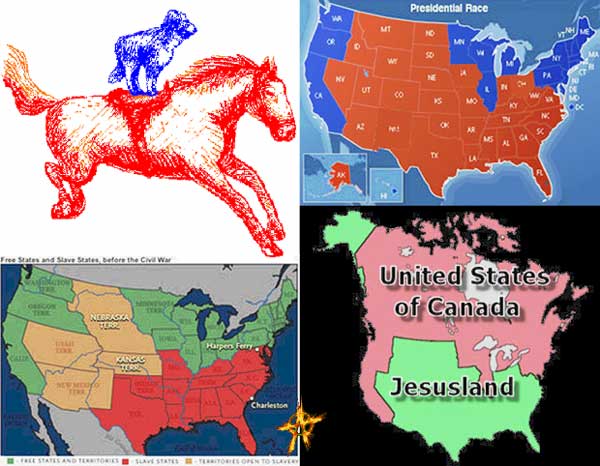
Red States VS. Blue States
9 TRILLION Dollars Missing from Federal Reserve, Fed Inspector General Can't Explain
*** 1958 ***
Mind blowing speech by Robert Welch in 1958 predicting Insiders plans to destroy America
Origin of "The Plan"
Closing Argument
Drop Dead ~ Telecom Crimes ~ Denialist ~ He Said It ~ Rethinking 9/11 ~ Are you better off?
Alan Shore: When the weapons of mass destruction thing turned out to be not true, I expected the American people to rise up. Ha! They didn't.
Then, when the Abu Ghraib torture thing surfaced and it was revealed that our government participated in rendition, a practice where we kidnap people and turn them over to regimes who specialize in torture, I was sure then the American people would be heard from. We stood mute.
Then came the news that we jailed thousands of so-called terrorists suspects, locked them up without the right to a trial or even the right to confront their accusers. Certainly, we would never stand for that. We did.
And now, it's been discovered the executive branch has been conducting massive, illegal, domestic surveillance on its own citizens. You and me. And I at least consoled myself that finally, finally the American people will have had enough. Evidentially, we haven't.
In fact, if the people of this country have spoken, the message is we're okay with it all. Torture, warrantless search and seizure, illegal wiretapping's, prison without a fair trial - or any trial, war on false pretenses. We, as a citizenry, are apparently not offended.
There are no demonstrations on college campuses. In fact, there's no clear indication that young people seem to notice.
Well, Melissa Hughes noticed. Now, you might think, instead of withholding her taxes, she could have protested the old fashioned way. Made a placard and demonstrated at a Presidential or Vice-Presidential appearance, but we've lost the right to that as well. The Secret Service can now declare free speech zones to contain, control and, in effect, criminalize protest.
Stop for a second and try to fathom that.
At a presidential rally, parade or appearance, if you have on a supportive t-shirt, you can be there. If you are wearing or carrying something in protest, you can be removed.
This, in the United States of America. This in the United States of America. Is Melissa Hughes the only one embarrassed?
*Alan sits down abruptly in the witness chair next to the judge*
Judge Robert Sanders: Mr. Shore. That's a chair for witnesses only.
Alan: Really long speeches make me so tired sometimes.
Judge Robert Sanders: Please get out of the chair.
Alan: Actually, I'm sick and tired.
Judge Robert Sanders: Get out of the chair!
Alan: And what I'm most sick and tired of is how every time somebody disagrees with how the government is running things, he or she is labeled un American.
U.S. Attorney Jonathan Shapiro: Evidentially, it's speech time.
Alan: And speech in this country is free, you hack! Free for me, free for you. Free for Melissa Hughes to stand up to her government and say "Stick it"!
U.S. Attorney Jonathan Shapiro: Objection!
Alan: I object to government abusing its power to squash the constitutional freedoms of its citizenry. And, God forbid, anybody challenge it. They're smeared as being a heretic. Melissa Hughes is an American. Melissa Hughes is an American. Melissa Hughes is an American!
Judge Robert Sanders: Mr. Shore. Unless you have anything new and fresh to say, please sit down. You've breached the decorum of my courtroom with all this hooting.
Alan: Last night, I went to bed with a book. Not as much fun as a 29 year old, but the book contained a speech by Adlai Stevenson. The year was 1952. He said, "The tragedy of our day is the climate of fear in which we live and fear breeds repression. Too often, sinister threats to the Bill of Rights, to freedom of the mind are concealed under the patriotic cloak of anti-Communism."
Today, it's the cloak of anti-terrorism. Stevenson also remarked, "It's far easier to fight for principles than to live up to them."
I know we are all afraid, but the Bill of Rights - we have to live up to that. We simply must. That's all Melissa Hughes was trying to say. She was speaking for you. I would ask you now to go back to that room and speak for her. ~ Boston Legal ~ Stick It ~ Season 2 ~ Episode 19 ~ [Video at link] ~ Written by David E. Kelley & Janet Leahy ~ Directed by Adam Arkin.
One Can Lead A Horse To Water, But ....
Until there is a solution for this, where one solution has been provided, Nobody will bring Peace to Our Times, feed the hungry, care for the sick, and bake apple pie better than Mom. (otoh) If None of the Above was on voter ballots, it would be a huge step towards recovering U.S. political control, and Nobody gets it.
American Dream ~ George Carlin/L.I.L.T ~ http://vimeo.com/72719973