Remnant of Paradise Continued by ~@~
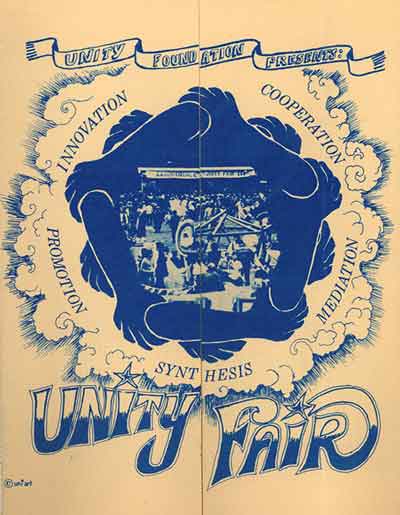
Mid '70s Unity Foundation Pamplet - Folded Front

There seems to be a consensus of Uninformed that believe: 'those who have a tendency to complain do not participate.'

Participation:

For close to a quarter century I served as 'Chairperson' of Unity Foundation and retired my position. - Curtis a.k.a. ~@~
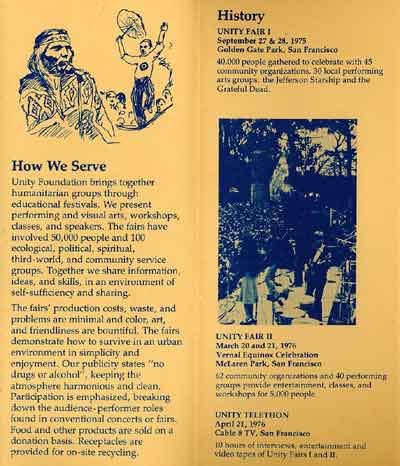
Mid '70s Unity Foundation Pamplet - Inside Left

How We Serve

Unity Foundation brings together humanitarian groups through educational festivals. We present performing and visual arts, workshops, classes, and speakers. The fairs have involved 50,000 people and 100 ecological, political, spiritual, third-world, and community service groups. Together we share information, ideas, and skills, in an environment of self-sufficiency and sharing.

The fairs' production costs, waste, and problems are minimal and color, art, and friendliness are bountiful. The fairs demonstrate how to survive in an urban environment in simplicity and enjoyment. Our publicity states "no drugs or alcohol", keeping the atmosphere. harmonious and clean. Participation is emphasized, breaking down the audience-performer roles found in conventional concerts or fairs. Food and other products are sold on a donation basis. Receptacles are provided for on-site recycling.

History

UNITY FAIR I
September 27 & 28, 1975
Golden Gate Park, San Francisco

40,000 people gathered to celebrate with 45 community organizations, 30 local performing arts groups, the Jefferson Starship and the Grateful Dead.

UNITY FAIR II
March 20 and 21, 1976
Vernal Equinox Celebration
McLaren Park, San Francisco

62 community organizations and 40 performing groups provide entertainment, classes, and workshops for 5,000 people.

UNITY TELETHON
April 21, 1976
Cable 8 TV, San Francisco

10 hours of interviews, entertainment and video tapes of Unity Fairs I and II.
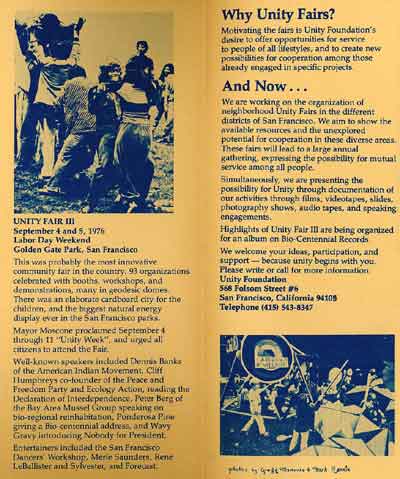
Mid '70s Unity Foundation Pamplet - Inside Right

UNITY FAIR III
September 4 and 5, 1976
Labor Day Weekend
Golden Gate Park, San Francisco

This was probably the most innovative community fair in the country. 93 organizations celebrated with booths, workshops, and demonstrations, many in geodesic domes. There was an elaborate cardboard city for the children, and the biggest natural energy display ever in the San Francisco parks.

Mayor Moscone proclaimed September 4 through 11 "Unity Week", and urged all citizens to attend the Fair.

Well-known speakers included Dennis Banks of the American Indian Movement, Cliff Humphrey co-founder of the Peace and Freedom Party and Ecology Action, reading the Declaration of Interdependence, Peter Berg of the Bay Area Mussel Group speaking on bio-regional re inhabitation, Ponderosa Pine giving a Bio-Centenial address, and Wavy Gravy introducing Nobody for President.

Entertainers included the San Francisco Dancers' Workshop, Merle Saunders, Rene LeBallister and Sylvester, and Forecast.

Why Unity Fairs?

Motivating the fairs is Unity Foundation's desire to offer opportunities for service to people of all lifestyles, and to create new possibilities for cooperation among those already engaged in specific projects.

And Now...

We are working on the organization of neighborhood Unity Fairs in the different districts of San Francisco. We aim to show the available resources and the unexplored potential for cooperation in these diverse areas. These fairs will lead to a large annual gathering, expressing the possibility for mutual service among all people.

Simultaneously, we are presenting the possibility for Unity through documentation of our activities through films, videotapes, slides, photography shows, audio tapes, and speaking engagements.

Highlights of Unity Fair III are being organized for an album on Bio-Centennial Records.

We welcome your ideas, participation, and support - because unity begins with you.
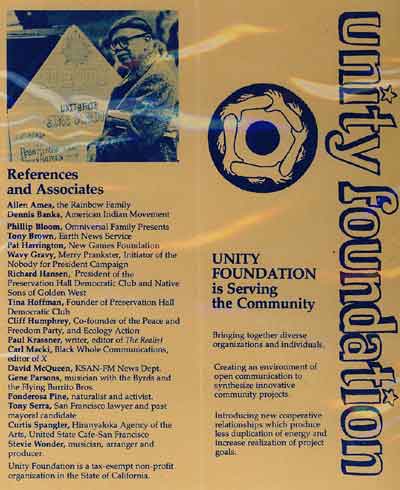
Mid '70s Unity Foundation Pamplet - Back

References and Associates

Allen Ames, the Rainbow Family

Dennis Banks, American Indian Movement

Phillip Bloom, Omniversal Family Presents

Tony Brown, Earth News Service

Pat Harrington, New Games Foundation

Wavy Gravy, Merry Prankster, Initiator of the Nobody for President Campaign

Richard Hansen, President of the Preservation Hall Democratic Club and Native Sons of Golden West

Tina Hoffman, Founder of Preservation Hall Democratic Club

Cliff Humphrey, Co-founder of the Peace and Freedom Party and Ecology Action

Paul Krassner, writer, editor of The Realist

Carl Macki, Black Whole Communications, editor of X

David McQueen, KSAN-FM News Dept.

Gene Parsons, musician with the Byrds and the Flying Burrito Bros.

Ponderosa Pine, naturalist and activist.

Tony Serra, San Francisco lawyer and past mayoral candidate

Curtis Spangler, Hiranyaloka Agency of the Arts, United State Cafe - San Francisco

Stevie Wonder, musician, arranger and producer.

Unity Foundation is a tax-exempt non-profit organization in the State of California.

UNITY FOUNDATION is Serving the Community

Bringing together diverse organizations and individuals.

Creating an environment of open communication to synthesize innovative community projects.

Introducing new cooperative relationships which produce less duplication of energy and increase realization of project goals.

http://www.unityfoundation.org/ - Current projects Unity Foundation is involved with.


From ka7axd Tue Jul 4 14:18:55 1989
Received: by ka9q.bellcore.com (5.60/4.7)
id AA22424; Tue, 4 Jul 89 14:18:55 EST
Date: Tue, 4 Jul 89 14:18:55 EST
From: ka7axd (Mike Horne)
Message-Id: <8907041918.AA22424@ka9q.bellcore.com>
To: dsp-local
Subject: yat

Yet another test.

Mike

From tcp-group-request@ucsd.edu Tue Jul 4 18:35:32 1989
Received: from ucsd.edu by ka9q.bellcore.com (5.60/4.7)
id AA00156; Tue, 4 Jul 89 17:35:22 EST
Received: by ucsd.edu; id AA27103
sendmail 5.60/UCSD-1.0
Tue, 4 Jul 89 13:05:59 PDT
Received: from ka9q.bellcore.com by ucsd.edu; id AA27092
sendmail 5.60/UCSD-1.0
Tue, 4 Jul 89 13:05:41 PDT for /usr/lib/sendmail -odq -oi -ftcp-group-request tcp-group-list
Received: by ka9q.bellcore.com (5.60/4.7)
id AA23545; Tue, 4 Jul 89 14:30:35 EST
Date: Tue, 4 Jul 89 14:30:35 EST
From: ka7axd@ka9q.bellcore.com (Mike Horne)
Message-Id: <8907041930.AA23545@ka9q.bellcore.com>
To: tcp-group@ucsd.edu
Subject: dsp-group@ka7axd roll call (so far)...
Status: R

> Since Mike's having problems with a mailer on the other side of...

Contrary to comments from Brian, the dsp-group@ka7axd.wv.tek.com is alive and
kicking (ka7axd is not experiencing any mailer problems, either side of
relay.cs.net). Thank you for the volunteer help, though, Brian. As of
today (in the wee hours of the 4th o' July) there have been several messages
regarding switched cap filters, the Ariel dsp board, the 56K, etc.

Currently the dsp-group is comprised of the following dsp-interested people:

bisbey@venera.isi.edu (Richard Bisbey - NG6Q)
bob@jvncb.csc.org (Bob Albrightson - N7AKR)
bottoms@radar.nrl.navy.mil (Maitland Bottoms - AA4HS)

cas@toad.com (Curtis Spangler - N6ECT)
clark@tomcat.gsfc.nasa.gov (Tom Clark - W3IWI)
daveb@wb3ffv.ampr.org (Dave Borden - K8MMO)
davem@tekfdi.fdi.tek.com (Dave McNeill - WB7BLB)
dsp-archive@ka7axd.wv.tek.com (DSP archive pseudo-person)
dsp-group@hp-col.col.hp.com (Bdale's redist list)
dsp-local@ka9q.bellcore.com (Phil's redist list)
gatech!stiatl!john@tektronix.tek.com (John DeArmond - WD4OQC)
gatech!uflorida!novavax!ankh!dsp-group@tektronix.tek.com (Garry's redist list)
gdtg@holmes.lcs.mit.edu (Greg Troxel - N1DAM)
glenne@hpnmd.hp.com (Glen Elmore - N6GN)
glens@tekigm2.men.tek.com (Glen R. Sands - KA7AYF)
idacrd!mac@tektronix.tek.com (Bob McGwier - N4HY)
jamese@tekfdi.fdi.tek.com (Jim English - WA7QLB)
johnl@n3dmc.uu.net (John A. Limpert - N3DMC)
mhorne@ka7axd.wv.tek.com (Michael Horne - KA7AXD)
n5x@psuvm.bitnet (Jim Mankin - KB3KJ)
nn2z@nn2z.ampr.org (Dave Trulli - NN2Z)
phil@east.berkeley.edu (Phil Lapsley - N6TCT)
pshen@atrp.mit.edu (Paul Shen)
uunet!ism780c!kodak!ornitz@tektronix.tek.com (Barry L. Ornitz - WA4VZQ)
uunet!nikhefh.hep.nl!henkp@tektronix.tek.com (Henk Peek - PA0HZP)

Again, to get your very own subscription to the dsp-group, send your name,
callsign, and a valid email address to:

dsp-group-request@ka7axd.wv.tek.com, or
dsp-group-request%ka7axd.wv.tek.com@uunet.uu.net, or
...{backbone}!uunet!ka7axd.wv.tek.com!dsp-group-request

To post messages to the group, send them to:

dsp-group@ka7axd.wv.tek.com

or appropriate permutation as shown above. Brian's guidelines that he has
set forth for the tcp-group should also be followed here (re: redistribution,
etc.).

I maintain archives of the dsp-group on a per-month basis, or finer resolution
as dictated by the volume of traffic. To receive archives, send the month/year
span of interest to dsp-group-request@ka7axd.wv.tek.com, and they will be
promptly shipped out to you. Better yet, if you have Internet access, the
archive can also be accessed via anonymous ftp from:

ka9q.bellcore.com (128.96.160.1)

in /pub/dsp/dsp-group.

Please send any questions or comments directly to me. Enjoy!

Mike
mhorne@ka7axd.wv.tek.com

http://www.nic.funet.fi/pub/cae/dsp/dsp-group/dsp-group-mails


Quake XQuake quake xquake

curtis (xxx@xxx)
Thu, 09 Oct 1997 12:04:39 -0700
axp-list@redhat.com

hi emilio,

due to the constant requests for information regarding quake, i am cross-posting this to the axp-list,...besides, it's chilly up here on the mountain (where i live), this morning, and a few flames (chuckle) might warm me up - NOT.

> On the other hand, when i try running quake i get the following:
>> From what i'm told this has to do with shared memory.
> Is there a way to turn shared memory on or off.

i'm not sure this is a ""verbatim"" "shared memory" problem (comments below).

> Excuse the ignorance but i'm trying to learn Linux since i'm a VMS user

(smile - learning is learning - and (imo) a good thing - no problem)

>everything seems so confusing or non organized with UNIX that i'm having a
> hard time getting this kind of detailed info.

(chuckle) maybe a first step towards "chaO.S." programming. seriously, this is why a lot of my old vms friends (i cut my teeth on an ibm360/20 back in 1966 and have played with various os/programming over the years- smile) use nt (despite their (imo) "valid" opinions of ms - chuckle). slowly, i am changing some of them to see the merits of what i consider to be the most advanced, experimental, "young" *nix os around, (smile) linux/alpha!

(sidebar) between my 266/udb and xlt300 (smile) i have incorporated so many bits and pieces of rh4.0/4.1/4.2/ (yup, i have all the cds') - milo 2.0.18 thru 2.0.31 - kernels 2.0.30 / 2.0.31 / 2.1.56 - em86 .1/.2, that i have (chuckle) given up on trying to define versions and libs. my only wish (smile - and i know what is said about wishing) is that i could run "rpm -Va" and not get any reports -- JUST ONCE! the same is true of source compilation -- JUST ONCE - "no warnings"..., but as they say, rome wasn't built in a day, so i have learned a lot about patience. if i haven't said it enough, "KUDOS" to the fine folks from dec and various linux orgs. who have consistently helped us. (soapbox mode off)

>**********************QUAKE ERROR MESSAGE
> **********************
>
> X Error of failed request: BadAccess (attempt to access private
> resource
> denied)
> Major opcode of failed request: 129 (MIT-SHM)
> Minor opcode of failed request: 3 (X_ShmPutImage)
> Serial number of failed request: 49
> Current serial number in output stream: 50
>
> **********************QUAKE ERROR MESSAGE**********************

(disclaimer)

i have never played with an as200-4/166, so this is speculation and i have had "no problems" running xquake on my machines. ((HOWEVER-BIG CHUCKLE) i would not advise running squake under em86 with a pnp sound card, unless you want to spend a week trying to figure out what happened to your sound.- whew!)

things to try:

start fresh: mount your quake cdrom and copy resourse.1 to: /usr/games/quake issue: lha -x resource.1 get rid of everything in the directory, except the id1 directory and the files (pak) therein. unpack your xquake tarball in /usr/games/quake.

issue: strace ./alpha-ELF-xquake > tracefile (take a look at tracefile to see what is happening when xquake fails)

issue: ./alpha-ELF-xquake -stdvid -safe

valid parameters for this version are: -nomouse -nojoy -nocdaudio -nolan -stdvid -safe -nosound -dedicated -listen (there are some others, but, i don't "think" they apply, "in this case").

NOTE::: once you get it running (this does not apply to 106xquake --- only xquake) you have to go into the console and issue (as you see it): disconnect ; map start

if "None of the Above" work, try this:

ftp gatekeeper.dec.com
ftp> bin
ftp> tick
ftp> cd /pub/DEC/Linux-Alpha/X11/
ftp> get axpbin-Xtga-BETA-0.2.gz
ftp> close
ftp> quit
gunzip -d /usr/quake/axpbin-Xtga-BETA-0.2.gz
mv /usr/X11R6/bin/XF86_TGA /usr/X11R6/bin/XF86_TGA.orig
mv axpbin-Xtga-BETA-0.2 /usr/X11R6/bin/XF86_TGA
then issue (in your quake directory): ./alpha-ELF-xquake

(note): don't forget to change back to your original XF86_TGA if this doesn't work.

Stefan van der Eijk <xxx@xxx> and John Ross Hunt <xxx@xxx> had some good observations in their "Subject: RE: Quake" posts to the axp-list (29 & 30 Sep 1977) and you might want to check them out.

nm <xxx@xxx> in a private note said:
> well i got it working!!!
>
> turns out i read a post on a news group that led me to
> the key...
>
> linus said his didnt work either so he released a fixed
> one, which worked for me :)
>
> xquake-1.06-alpha-bin.gz :) <this one works fine for me too - curtis>

(moving right along):

the "base" error messages (above) come from /usr/X11R6/lib/X11/XErrorDB ...so my first assumption is: check your X stuff. i'm running the XFree86 3.3.1-1 rpms' on both of my machines.

i do not have the quake source...(smile)...which doesn't make this easy. however, ("attempt to access private resource"), (guess only) may have something to do with Xlib and a fail on quake's VID_Update, producing the X_ShmPutImage message. if you take a look at: /usr/X11R6/include/X11/Xlib.h you will notice "Structures and symbols starting with "_" are private to the library." which (to me) might be a clue.

"audio" - just to be safe check these ((pertinent to onboard MSS ONLY)): ((may vary on different systems - "i don't know" - taken from my udb)) take a look at /etc/soundconf (here's mine):

#define CONFIG_MSS
#define CONFIG_AD1848
#define CONFIG_AUDIO
#define MSS_BASE 0x530
#define MSS_IRQ 9
#define MSS_DMA 3
#define SELECTED_SOUND_OPTIONS 0x00000200

cat /proc/devices 14 sound
cat /proc/dma 3: Sound System
cat /proc/interrupts 9: 111 SoundPort

--
on another note: do you have /etc/nsswitch.conf ?
--

if you really want to get into it, you may also want to check with the: X Consortium.

here's a good place to keep up with quake and linux (the links as well):

http://threewave.planetquake.com/linux/quake.html

it might be time to construct a linux/alpha xquake FAQ, which might be a good addition for this (above) and other linux/quake sites. i am too far behind on other projects to take this on myself (smile) volunteers?

....and don't forget to search the axp mail archives located at a number of sites for old "quake/xquake" posts.

good luck n'very best2u all,

--
curtis - alt.old.good.but.rarely.used.address: cas@toad.com
i want Nobody to control my life. - http://www.netvideo.com/nobody
< cspang@mit-ai, l5!cas@lll-crg, cas@su-shasta, rtfm@jnb - (retired)>
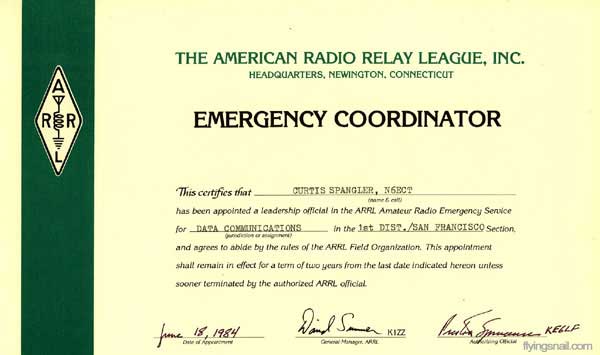

N6ECT - ARRL Emergency Coordinator, Data Communications

During the 1970s, Fred Bray, KE6CD (Emergency Coordinator Radio Communications) and I (Emergency Coordinator Data Communications) provided the Mayor's Office of Emergency Services a complete FREE Emergency Disaster & Evacuation plan for the City of San Francisco, as a service of the Amateur Radio community.
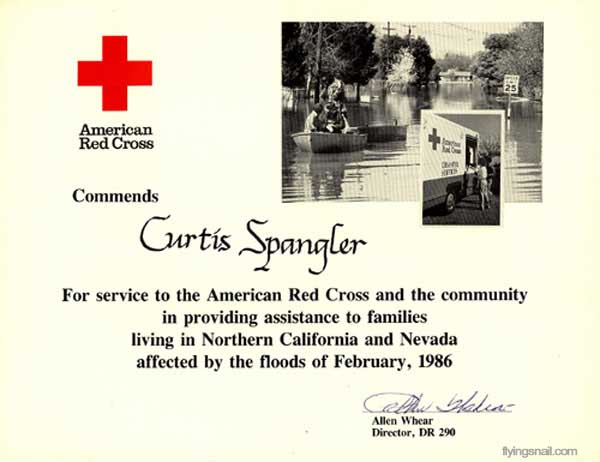
Commendation from Red Cross

Western Field Office
1870 Ogden Drive
P.O. Box 909
Burlingame, California 94010
(415) 692-5201

American Red Cross

May 20, 1986

Dear Curtis,

What a pleasure it was to work with you during the disaster! I learned so much, and was able to relay it in a coherent manor to the DWI [Department of Welfare Inquiry] Task Force. It helped so much when we wrote our proposal to National Headquarters and they bought it all. I'm sure the little chart you drew was a big help -- Stan Sneed came to our final planning meeting and gave a good deal of computer type input too. Now we begin the search for funds!

You were so terrific to hang in and do so much to make the DWI operation work -- and we appreciated it so very much.

Helen R. Smith
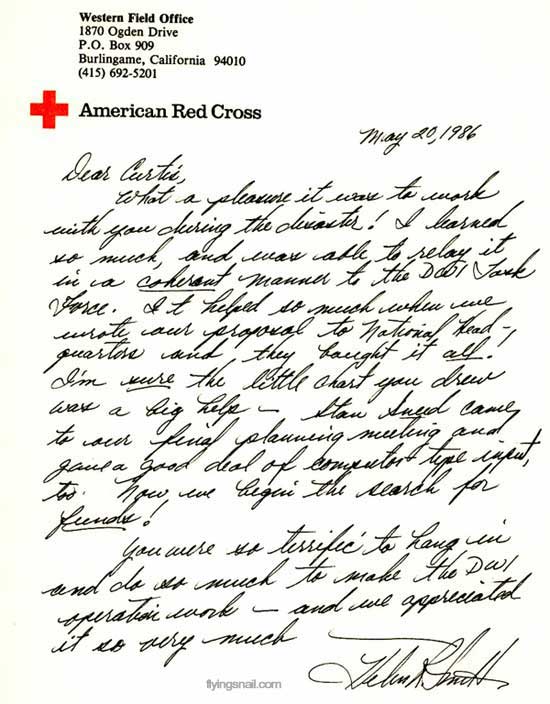
Thank You Letter from Red Cross


San Francisco CommuniTree - 1978
In Memory of Dean Gengle

Fairwitnessing

APPENDIX B: Amateur Radio Conference Printout

The following is a sample printout of the Amateur Radio Conference currently running on CommuniTree No. 2, in San Francisco. The conference Fairwitness is Curtis Spangler, who became the world's first real-life Fairwitness as soon as he found out what a Fairwitness is. Thanks, Curtis.

*** AMATEUR.RADIO 1-JUN-81
PARENT=CONFERENCES USAGE=104
This branch is dedicated to Amateur Radio. Please feel free to add any information or comments. -cas-
+++ SUBMESSAGES +++

**** SOLAR.HOTLINE 1-JUN-81
PARENT=AMATEUR.RADIO USAGE= 73
A solar event hotline service is being provided jointly by the National Aeronautics and Space Administration (NASA) and the National oceanic and Atmospheric Administration (NOAA). Information on sunspots, solar flares, geomagnetic storms and the impact of the sun's behavior on radio transmissions will be provided in daily recorded messages from the Goddard Space Flight Center in Maryland. The telephone number is (301) 344-8129. The daily recordings will serve Amateur Radio operators interested in the sun's activities.

*** *RTTY I-JUN-81
PARENT=AMATEUR.RADIO USAGE= 69
This area is for RTTY related subjects -.-

*** K6GWE/R 1-JUN-81
PARENT=*RTTY USAGE= 69
Ok ... K6GWE/R (147.93/33) RTTY repeater .... 45.45 Baud (60 wpm) 170 Hz shift (2125 Hz mark/2295 Hz space) Mark tone to access repeater All welcome. Repeater also has it's own "mailbox", accessed by "MBX de <your call> Help" Also, some simplex stuff, from 100 wpm baudot, to attempts at 110 baud ascii on or around 145.61 (simplex). - 8107.26 CommuniTree -- First Edition Page 124

(Copyright @ 1981 Smith & Gengle) - http://www.flyingsnail.com/missingbbs/CommuniTree.html

Page Source - Hackers - The Missing BBS Files - http://www.flyingsnail.com/missingbbs/index.html


<sigh>

Newsgroups: net.ham-radio
From: sun!gnu
Date: Wed Mar 9 03:41:29 1983
Local: Wed, Mar 9 1983 3:41 am
Subject: My comments to the FCC on the No Code NPRM -- did you submit yours yet?

Before the
FEDERAL COMMUNICATIONS COMMISSION
Washington, D.C. 20554

In the Matter of )
) PR Docket No. 83-28
Establishment of a Class of )
Amateur Operator License Not )
Requiring a Demonstration of )
Proficiency in the International)
Morse Code. )

COMMENTS

I am overjoyed to see a proposal for a codeless Amateur Radio
Operator's License.

I am a computer programmer, 27 years old, with more than 10
years' experience in computers. Two years ago I became heavily
involved with the local Amateur Packet Radio group, headed by
Hank Magnuski, KA6M. (The group has since become the Pacific
Packet Radio Society.) At that time there were about 30 people
in the group. I was excited by the idea and the potential of
packet radio and was willing to learn and to help it get going.

I started collecting information and equipment. I subscribed to
the newsletters of the Vancouver Area Digital Communications
Group and the Hamilton (Ont.) packet radio club, and bought the
AMRAD Packet Radio Conference proceedings. I bought a 1200 baud
modem and a packet radio "terminal node controller" board. I
started reading listings of the software that runs in the
controller board. I reviewed a Canadian book (from Tab Press)
on packet radio.

At the same time, I was attending Packet Radio meetings and
meeting many of the hams involved. I discovered that, to
connect a radio to my computer and send 1200-baud ASCII computer
data over the air, I was required to deal with a Federal agency
and to learn an archaic transmission code well enough to decode
it in my head "on the fly". I began to see why packet radio was
still holding meetings and not building a network.

I'm not sure how familiar you are with the history of the
computer industry. I am not the person to teach it, but one
thing has been clear to me: Much technological progress has
occurred because anyone could attempt to design and build an
improved anything -- hardware, software, communications network,
mass storage device, you name it -- and it was NOT controlled
by the Government, choked by bureacracy, or shielded by special
interest rules and legislation. If I liked ASCII better than
EBCDIC for my application, there was nobody who could force me
to use EBCDIC. If I found a way to store twice as many bits
on a disk, or push twice as many down a local area network
cable, the marketplace and my organizational ability would
decide whether my invention was worth its salt.

I began to learn about Amateur Radio from the hams around me.

Here is what I learned:

* Whether or not I ever USE Morse code, I need to learn it
to pass this test. Being able to write a program that can read
it off the air and translate to ASCII on my screen is not good
enough. The idiot work must be done by a human to be
worthwhile.

* If I don't go get a license, but just set up a radio and
a modem and start transmitting, I am committing a Federal crime,
and there are plenty of old hams who do nothing but sit in their
homes and listen for people like me so they can turn me in to
the Feds. This is true whether or not I cause any harm or
interference to anyone else.

* It's theoretically possible to run our packet radios
faster than 1200 baud -- in fact by using telephone style modems
we are using a lot more bandwidth than we need -- but it would
take a special variance from the FCC even to experiment with it,
and there's no guarantee that it would ever be legal for the
general public anyway.

* Yes, I could hook up a packet radio to my Computer
Bulletin Board System (which had been running for about a year,
accepting public telephone calls on my Apple computer to allow
people to send and receive messages with each other) and let
people send and receive messages over the radio, but there are
laws that require me to be there at all times so I can cut them
off if they swear or something. (I need a "control operator".)
Furthermore, I can't pass "third party traffic" and if someone
might use my system instead of making a toll phone call then I
am illegally using amateur radio to steal business from the
phone company.

* I have some good ideas, but why don't I go get a license
and then I'll really have something to say. My opinion is not
worth much because my name doesn't have random letters and
numbers after it. (This was not true of everyone but was
definitely there in some.)

This was daunting, but I still had enough excitement and energy
to continue working. (Partly, I couldn't believe things were
really that bad. If I built a packet radio station and got it
working and providing a useful service to the Amateur community,
nobody would really play straight-and-narrow with the rules,
would they?) I bought parts for my Terminal Node Controller
board and started to build and debug it -- buying and borrowing
tools and equipment, setting up a room in my house for
electronics work. I got a copy of the FCC Working Paper on
deregulation of Amateur Radio and prayed and tried to get people
to read it. I enrolled in the San Francisco Radio Club's class
for novices and started to learn radio theory (easy), regulations
(rote memorization), and Morse code. I kept going to Packet
Radio meetings and eventually ended up on the Steering Committee
-- it turned out that since many of the hams there had little
computer experience, they'd never been exposed to networking
concepts, ideas, or implementations. As a result I was one of
the three or four people in the club who could actually
UNDERSTAND the protocol being used and the program that
implemented it. "They also serve who stand and rag-chew", I
guess, but they weren't helping to design the network, which I
was.

Alas, my Morse Code classes weren't going very well. They were
trying to teach at 15-18 words a minute, so we'd eventually be
comfortable at 13 words a minute. It was an effort, and I
wasn't interested; I was interested in getting past the
regulations so I could start to get some real work done. The
radio theory was going fine and there was interesting
information there, things that I would need to know. But after
a month of two-night-a-week classes, I dropped out. We hadn't
even been taught all the letters yet!

I tried to stir up some sentiment in the Packet Radio Society
that we should work towards a code-free license, by passing a
resolution and sending it to the FCC, ham magazines, etc. The
general feeling was that I should get a license first and then
they'd think about it.

I tried to find out why people felt so strongly about Morse
code. Most of them admitted that they never used it themselves
except for I.D.; they all used voice and packet. So what was
the fuss? Here were some answers I got. Some were used as
arguments, some were told in private by friends, some were
figured out by me:

* We had to do it, so you will too. No punk kid is going
to get away with getting in easy when I had to pay my dues.

* If we removed the code test, the airwaves would be flooded
with trash. It would be just like CB. We've got to hold on to
the spctrum space and not let it get crowded or it won't be any
good anymore.

* It's not such a big deal, it only took me a week, so
what are you so worried about?

* That's the way it is and you'll understand after you've
been in this field as long as I have.

* It's useful in emergencies, you might hear an SOS that
nobody else hears and save a life.

* You could transmit using nothing but a rusty spoon and a
piece of rock when the earthquake happens and your packet radio is
smashed.

* It can get thru many kinds of interference that voice
and computer data just can't penetrate.
Some of these need no rebuttal, but others might:

* The airwaves belong to "the public". Hams seem to feel
that the airwaves belong to hams -- that it's fine for them to
carry around a handy-talky and talk to their friends all day on
the repeaters, but for the general public to do that would spoil
their game. They aren't advancing the state of the art of radio
-- why do they get privileged use of the airwaves?

* If the communications modes in use now are too crowded,
the solution is not to create a privileged class -- the solution
is to use new modes, such as packet rather than Morse, which
allow more people to share the same channels that are now
crowded.

* Maybe with the right teacher it IS possible to learn the
code in a week. I didn't get that teacher. Mine tried to teach
me far more than I wanted to know or needed to know. As a
result, I never learned it -- should that be a reason to keep me
from advancing the state of the art of radio networking?

* Cardio-Pulmonary Resuscitation and first aid are useful
in emergencies too, but not knowing them doesn't keep you from
getting a ham radio license. The government can encourage
emergency preparedness but to mandate it just means that people
who would contribute in other ways won't contribute at all.

* After the earthquake there will be several thousand
voice handy-talkies around, as well as good old CB radios.
Civilization is not going to disappear from the Earth without
killing all the humans too, so building radios from natural raw
materials is not going to be a problem.

* Packet radio gear automatically detects garbled
transmissions and will retry them without my even noticing most
of the time. If packet won't get thru and it's really
important, of course, I'll use the telphone. I can always use a
program to transmit and receive in Morse when conditions are bad
and the phones are down, if I ever need to -- the same way I'd
use a program to talk packets (much faster) under normal
conditions.

Meanwhile, back in the hardware lab, the circuit board I was
building was giving me problems. I'd tried to replace the
memory section with one that only required 5 volts instead of 5,
12, and -5, and had a power supply that was too small for the
board. I had managed to burn out 3 or 4 central processor chips
and possibly some of the auxiliary chips while debugging. The
board worked once in someone else's system but I never got it to
work by itself.

Between the lack of support on the code&license question, and
the hardware problems, my active interest in packet radio
started to dwindle. I kept attending meetings and talking with
Hank (KA6M) on the protocol, but eventually sold the circuit
board to someone who could debug it, returned the borrowed
scope, disassembled the wire-wrapped PROM burner, and went back
to working on software. To this day I haven't made an active
contribution to the technical art of packet radio -- I've
critiqued several designs and offerred suggestions, but I never
got the chance to work on the software or hardware to actually
implement the designs.

That's where the crying need is now. There are plenty of people
who know how to build a radio, put up an antenna, organize a ham
society. There are only two people in our group (of about 40,
still) who have worked on the software, though -- and they
aren't likely to get new recruits who aren't already hams. For
someone coming from the free-and-easy world of computers, coping
with the attitudes of hams and the bureacracy that governs their
behaviour is a serious problem. We and the other packet radio
groups would like to build a nationwide network of
store-and-forward packet radio repeaters. This requires a lot
of work -- much of it organizational, some of it in hardware,
and a lot in software.

That's where I can make my contribution -- except there's a
whale in the way. You, the FCC, are that whale. When I gave
up, I resolved to just sit back and wait until the ham radio
situation straightened itself out (if ever) before attempting
again to contribute. The current proposal (for a code-free
license) is a step in the right direction. If you implement it,
I will get a license (although that alone will probably take six
months of paper-shuffling) and get some more hardware and go
back to trying to do some good for the packet radio world. If
not, I'll sit waiting in the wings until some of the old (and
young) reactionary hams die off and maybe there is some
acceptance of new ideas.

My ultimate fantasy is to see black boxes with an RS232 (serial
computer data connector) plug on one end and an antenna on the
other. Anyone could walk into their favorite computer store,
Radio Shack, or ham store, and buy one, plug it into their home
computer, and be interconnected with the other packet radio
users in their city (and thru their city's connection to the
packet radio backbone network and packet radio amateur
satellites, to all other packet radio sites in the world).

Right now, due to earlier FCC deregulation efforts, that kind of
networking is possible with a 300-baud direct-connect telephone
modem -- and thousands of people have bought and used them for
exactly that (such as with my Apple Bulletin Board System).
Curiously enough, visitors from other countries express the same
incomprehension at seeing this that hams express at the idea of
people just buying a packet radio and turning it on.

The problems with telephone modems are that they are slow and
only provide local communication -- nobody can afford to use one
for long-distance communication unless they can write it off as
a business expense.

Imagine what would occur if you could buy an Atari or Apple or
IBM home computer with a communications box -- one that didn't
cost $20/hr on the telephone, but still put you in touch with
the world. I've been using computer networks for close to 10
years and I have some idea of the amount of information that
would be available -- that would make peoples lives and jobs
easier -- that would provide conversation and company to people
who are feeling alienated -- that would provide a forum for
people upset or enraged or interested in a public discussion --
that would bring the Information Age into the homes of the
people, not for the benefit of a corporation, not with a
monopoly deciding what information would get into the network
and who would get it out, but for the benefit of all the people
helping each other to build their dreams, share their knowledge
and their energies and their pleasures, and live their lives a
little closer to the way they want them.

There are people attempting to build the first hardware toward
this vision -- the Tucson Amateur Packet Radio Society. (Their
box does not include the radio; you have to add a handy-talky.)
There are people, of whom I am one, working on and using
networking software that connects over four hundred diverse
computers around the world into an anarchistic computerized
forum -- controlled by no-one, participated in by all. (All
messages are transferred over phone lines, and any long-distance
calls are paid for by business and University computer budgets.)
This network is called the Usenet and much of its software is in
the public domain. I and others from the computer field can
adapt this, and other, software, and contribute the knowledge of
networking required to make it work. There are people who have
been trying to design "WorldNet" for years now -- figuring out
the software and administrative requirements for a network that
anyone could connect to or disconnect from at will, a network
that could handle a million or 100 million users, in their usual
state of motion and change, without falling apart. We're
professionals who realize the potentials and are afraid that, as
in the past, most of the benefits of computer technology will
continue to go to businesses and governments, operating to
restrain peoples' choices instead of expanding them, giving the
public pay-TV, video games, and central control over information
distribution, instead of an improved society.

But WorldNet is still a fantasy. Some of the problem is
economics -- technology is taking care of that. Most of the
rest of the problem is governments. Within the U.S., that means
the FCC. Even with a code-free license, a license is still
required, classes have to be taken, there's an N-month delay
while the bureacracy shuffles your papers. To many people, it's
just not worth hassling with -- there are so many other
interesting things that they could be doing with their computers
-- they'll find another interest. One where they can walk in,
buy it, and use it, without asking the government. And those
places are where the products will be introduced, where the
technical advances and the price reductions will be made, where
the public will be served. Not in packet radio or WorldNet.
Not unless the regulations get as loose as CB, or looser.

I realize that it takes time to dismantle a legacy of
bureacracy, and I've been encouraged in recent years to believe
that is the job the FCC has undertaken to do. The code-free
license is an important step on that path, and no matter how
much it angers the existing special-interest-group (many Amateur
Radio Operators), it will be for the ultimate good of the
country and will contribute to the world's progress both in the
radio art and in the improvement of the general quality of life.

I believe that removing the current Morse code requirement from
the Technician Class license is the best way to introduce the
code-free license into the existing licensing structure. It
significantly reduces the administrative burden on the FCC
without significantly altering the requirements of the license
or the privileges granted by it, in comparison with the proposed
Experimenter Class. It also imposes no new burden on the ARRL
volunteer licensing program (except larger volumes of people
taking the existing tests, which the ARRL can hardly object to).

I furthermore believe that the frequencies and transmission
modes authorized for the codeless license should be the same as
those of the current Technician's and General licenses (subject
to restrictions imposed by international agreements). I believe
that, in general, the introduction of new communications methods
into the Amateur service will be hastened by as few restrictions
and regulations as possible; a competent Technician should not
be required to upgrade her or his license to use a frequency
band or a transmission mode which was previously unused for
similar methods. In other words, as many possiblilties should
be legalized at once as is possible, to avoid later having to
spend time removing restrictions, and to avoid discouraging good
new ideas because a long-drawn regulatory process is required to
experiment with them. I realize that some areas must be
reserved for Advanced and Extra classes as an incentive measure,
but this should not be applied such that the set of available
frequencies for experimental Technican and General use is too
small.

In particular, almost all current Packet Radio work is going on
in the 2-meter bands, because equipment is cheap and plentiful.
If the 2-meter band was not available, packet development work
would have to move to 220 or 440MHz where equipment is costlier.
This would also split the existing packet radio groups between
old-timers who could continue to use 2 meters, and newcomers
who'd be forced into other bands.

I note that the ARRL's editorial against this proposal (March
1983 QST, page 9) never once mentions an argument against the
proposal; it simply states that most amateurs oppose it, and
rages against the FCC's refusal to obey the ARRL in this
important matter. Personally, I'm on your side.

I have enclosed a few comments that were exchanged on the Usenet
(the computer network mentioned above) on the subject of
code-free licenses. I have also put these comments into the
Usenet, and encouraged others to send their own. A few sentences
will clear up some terminology problems: Phrases like
"decwrl!decvax!harpo!floyd!peri!sbcs!rick" identify the path
that the message has taken thru the network, from Rick on
machine "sbcs" (SUNY Stony Brook computer science dept.), thru
machine "peri", to "floyd", and so on to "decwrl" (Digital
Equipment Corp's Western Research Lab). A "flame" is a heated
reply; e.g. a response made while annoyed, rather than after
deliberation. The enclosed are only a few of the comments that
were made on the topic; I started to save them but quickly
realized that there were far too many messages to save, so these
are only the first few. The last message was sent by me in
response to a general "Hey, has anybody used packet radio out
there?" query.

Respectfully submitted
7 March 1983

John C. Gilmore
Sun Microsystems, Inc.
2550 Garcia Ave.
Mt. View, CA 95051
(415) 960-1300 x309

CC: Usenet newsgroup net.ham-radio
Hank Magnuski, KA6M
Curtis Spangler, N6ECT
Vic Clark, W4KFC
Paul Rinaldo, W4RI

Source

</sigh>


[To Be Continued and Updated]


Previous Home Next

Valid XHTML 1.0 Transitional