Amateur Radio
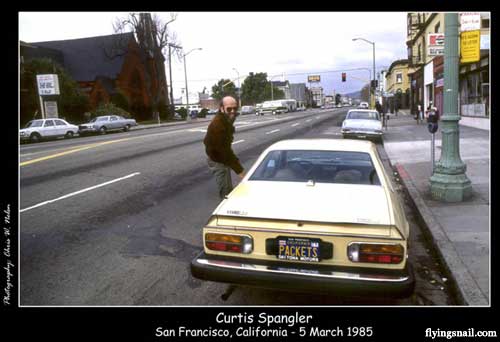
C. Spangler ~ Packets Photograph by Chris Nelson
I became interested in Amateur Radio during the summer of 1952.
I 'hung out' with a kid, on the weekends, that lived near one of my Grandparents' homes and his father was a General Class amateur radio operator, who had built 'all' of his equipment; including a very large beam antenna, mounted on a 75 foot [telephone style] pole.
On Saturday mornings we would get together before childrens' radio shows began and communicate with anyone who was willing to talk to us via amateur radio using morse code.
(fwiw) Television signals did not reach this area, at that time, and the only form of corporate media was AM radio, 78 RPM records, 45 RPM records, and movies.
I eventually ended up with a 1st Class F.C.C. license, which allowed me to work in radio and television, and an Amateur Extra Class F.C.C. license, N6ECT, which allowed me to do, what I consider, some 'neat' things.
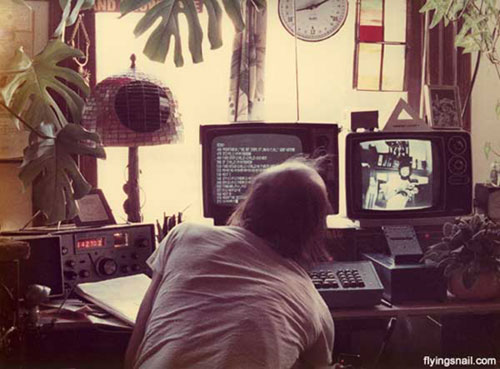
For example, I was able to receive pictures from the Mars Viking Lander via J.P.L. (Jet Propulsion Laboratory) using SSTV (amateur slow scan television)
from my home:
C. Spangler Photograph by Dwight DolliverThe most fortuitous station worked early in the event was Mel, W6VLH, who asked if we would be on SSTV. Our answer was negative, that no one in our club had the equipment. A couple of days later, we received a call from Robot asking what equipment we needed for SSTV operation and if they could loan it to us! Thus began one of the most wanted SSTV operations in the world. Jim, WA6MYJ, and Stan, K6YYQ, operated most of the SSTV (since the equipment was on loan, we were sensitive as to its use.) Pictures of Mars from both the Viking Orbiter and Lander were aired over N6V, occasionally into areas where there was little or no news coverage of the mission. A most memorable QSO was: "N6V de CZ20 ... What are those pictures you are sending? They look like the surface of Mars!" "CZ20 de N6V ... That's what they are!" We felt good that the pictures were recognizable. We are grateful to the JPL Public Information Office for providing us with the high quality photographs for our transmissions. We also had a direct video feed to the shack which allowed us to monitor and transmit some of the photos "live" from Mars as they were received here on Earth and processed by the computers. Jose', YV5FBL, Caracas, Venezuela, was late to a ham club meeting when the XYL said the rest of the club would not believe him unless he had tapes to prove it. At least one ham, Bill, W1PFA, was able to have his Polaroid photo of our transmissions published in the local newspaper, and then sent us a clipping. Bruce, VK3VF, sent impressive photos of a couple of pictures he received and also submitted to the newspaper. VE3AXC arranged to have TV news coverage live while receiving SSTV. Our local KABC-TV news team covered our operation in the Los Angeles area. We would greatly appreciate receiving any clippings you have managed to have published.
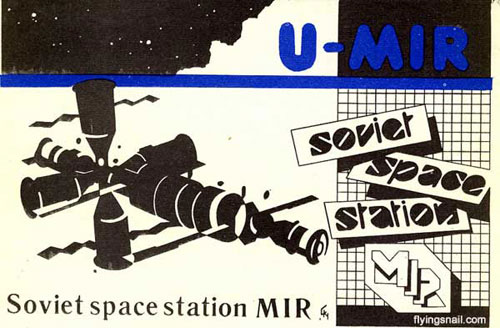
communicate with MIR, the Soviet Space Station, February 25, 1989, from my home:
and with Spacecraft Columbia, from my home November 28, 1983, special thanks to NASA:
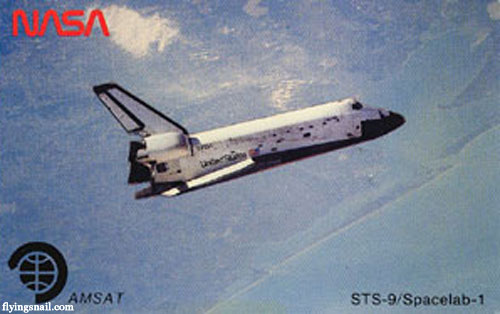
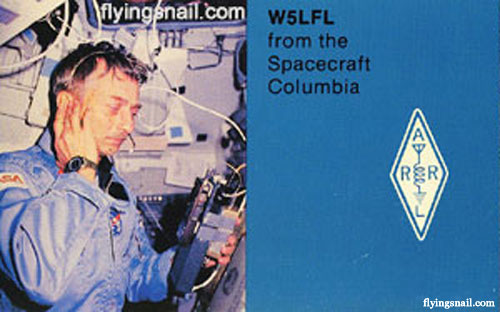
Owen Garriott, W5LFL from the Spacecraft Columbia
Another reason why I liked Amateur Radio was because most operators provided free Community Service communications for their area emergency services ... and beyond. The following are a few of the many things I have participated in:
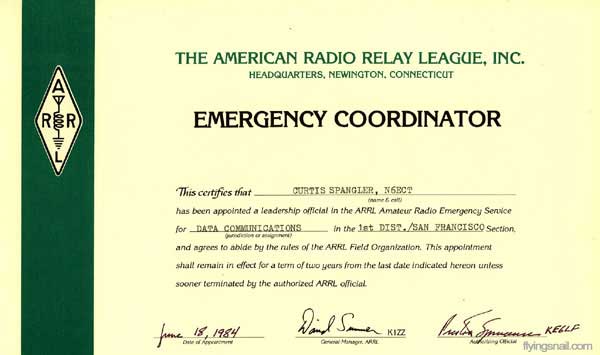
THE AMERICAN RADIO RELAY LEAGUE, INC.
HEADQUARTERS, NEWINGTON, CONNECTICUT
EMERGENCY COORDINATOR
This certifies that CURTIS SPANGLER, N6ECT
has been appointed a leadership official in the ARRL Amateur Radio Emergency Service
for DATA COMMUNICATIONS in the 1st DIST./SAN FRANCISCO Section
and agrees to abide by the rules of the ARRL Field Organization. This appointment
shall remain in effect for a term of two years from the last date indicated hereon unless
sooner terminated by the authorized ARRL official.
June, 18, 1984, David Summer, K1ZZ, General Manager, ARRL, Preston Spruance, KE6LF, Authorizing Official
[Note: I served as Data Communications coordinator for ten (10) years.]
During the 1970s, Fred Bray, KE6CD (San Francisco Emergency Coordinator Radio Communications) and I (San Francisco Emergency Coordinator Data Communications) provided the Mayor's Office and Emergency Services a complete FREE Emergency Disaster & Evacuation plan for the City of San Francisco, as a service of the Amateur Radio community and San Francisco Radio Club
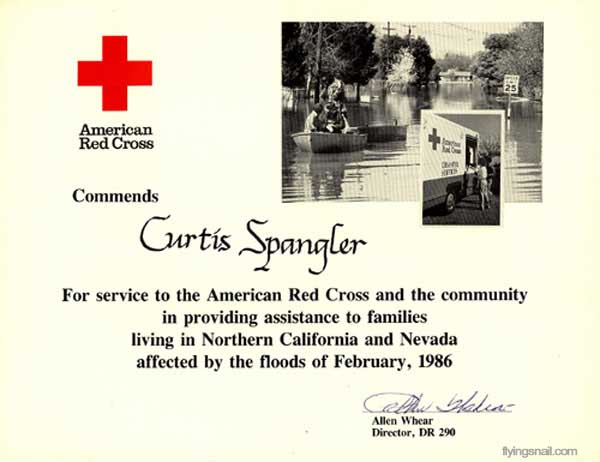
American Red Cross
Commends
Curtis Spangler
For service to the American Red Cross and the community
in providing assistance to families
living in Northern California and Nevada
affected by the floods of February, 1986
Allen Whear
Director, DR 290
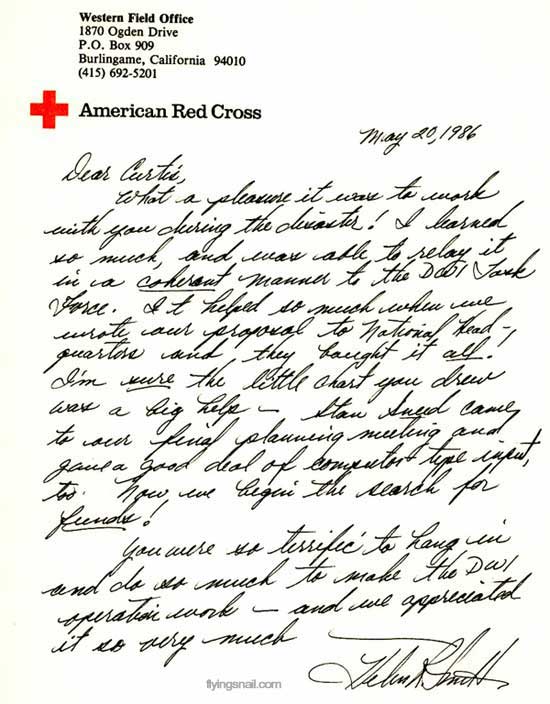
Western Field Office
1870 Ogden Drive
P.O. Box 909
Burlingame, California 94010
(415) 692-5201American Red Cross
May 20, 1986
Dear Curtis,
What a pleasure it was to work with you during the disaster! I learned so much, and was able to relay it in a coherent manor to the DWI [Department of Welfare Inquiry] Task Force. It helped so much when we wrote our proposal to National Headquarters and they bought it all. I'm sure the little chart you drew was a big help -- Stan Sneed came to our final planning meeting and gave a good deal of computer type input too. Now we begin the search for funds!
You were so terrific to hang in and do so much to make the DWI operation work -- and we appreciated it so very much.
Helen R. Smith
Curtis Spangler - The CommuniTree's First FairwitnessSan Francisco CommuniTree - 1978
In Memory of Dean GengleFairwitnessing
APPENDIX B: Amateur Radio Conference Printout
The following is a sample printout of the Amateur Radio Conference currently running on CommuniTree No. 2, in San Francisco. The conference Fairwitness is Curtis Spangler, who became the world's first real-life Fairwitness as soon as he found out what a Fairwitness is. Thanks, Curtis.
*** AMATEUR.RADIO 1-JUN-81
PARENT=CONFERENCES USAGE=104
This branch is dedicated to Amateur Radio. Please feel free to add any information or comments. -cas-
+++ SUBMESSAGES +++**** SOLAR.HOTLINE 1-JUN-81
PARENT=AMATEUR.RADIO USAGE= 73
A solar event hotline service is being provided jointly by the National Aeronautics and Space Administration (NASA) and the National oceanic and Atmospheric Administration (NOAA). Information on sunspots, solar flares, geomagnetic storms and the impact of the sun's behavior on radio transmissions will be provided in daily recorded messages from the Goddard Space Flight Center in Maryland. The telephone number is (301) 344-8129. The daily recordings will serve Amateur Radio operators interested in the sun's activities.*** *RTTY I-JUN-81
PARENT=AMATEUR.RADIO USAGE= 69
This area is for RTTY related subjects -.-*** K6GWE/R 1-JUN-81
PARENT=*RTTY USAGE= 69
Ok ... K6GWE/R (147.93/33) RTTY repeater .... 45.45 Baud (60 wpm) 170 Hz shift (2125 Hz mark/2295 Hz space) Mark tone to access repeater All welcome. Repeater also has it's own "mailbox", accessed by "MBX de <your call> Help" Also, some simplex stuff, from 100 wpm baudot, to attempts at 110 baud ascii on or around 145.61 (simplex). - 8107.26 CommuniTree -- First Edition Page 124(Copyright @ 1981 Smith & Gengle) ~ CommuniTree.html
Page Source - Hackers - The Missing BBS Files - MissingBBS
Dia (CommuniTree genealogical chart)
Let's look at some of the earliest electronic virtual communities. This kinship chart shows the origins of the first computer bulletin boards (BBSs) that supported social interaction. Prior to this moment, BBSs messages were organized by alphabetical order, or by date. BBSs were metaphors for physical bulletin boards... objects for the exchange of simple messages, not conversations. Now, in 1978 a group of people in Northern California designed a BBS that used message attachment protocols that facilitated conversations. As a metaphor for this structure they used a tree, firstly because it was based on a principle of computer science called binary tree protocol, and secondly because Northern California near Silicon Valley was a land of hot tubs, Eastern mysticism, and computer hackers, and the organicity that the word "tree" suggested was important to those hackers' worldview.
The story of the life and death of the first CommuniTree tells us how and why the later virtual community systems were designed. The original CommuniTree was designed with the idea that the community it facilitated would be completely free. Anyone could enter any sort of message. In fact, censorship was completely prohibited at the level of the code, of the Tree's program. It worked this way: First, the system operator was prevented from reading messages as they arrived. Second, messages were hard to remove once they were entered. Third, anything could be entered into the system, including so-called control characters, which are not part of the standard alphanumeric set and which can be used to control the operation of the host computer. Lastly, to make sure that no system operator could tamper with the system, the code was written in language called Forth, and not documented. Now Forth is a religion unto itself, and if you know anything about Forth you recognize that this makes the system a total black box -- it's impossible to know anything about how the code works.
CommuniTree went online in 1978. The kinds of conversations they had in there were of a high intellectual and spiritual character. They talked about new philosophies and new religions for post-Enlightenment humanity, the first time such conversations had taken place online.
Now, at the same moment Apple Computer had reached an agreement with the U. S. Government that in return for a tax break, Apple put computers into primary and secondary schools in the U.S., and some of those computers had modems. This meant that quite suddenly a lot of kids could get online. At first both boys and girls had access, but the boys quickly elbowed the girls out of the way -- high tech was men's work. The boys quickly found out CommuniTree's phone number and logged on. They were clearly unimpressed with the high intellectual level of the discourse on CommuniTree, and they expressed their dissatisfaction in ways that were appropriate to their age and linguistic abilities. Now, the hardware of the Tree was the best that Apple had to offer in 1978, it had two floppy disk drives with a combined total of 300 kilobytes of storage. At the time, the folks who designed the Tree said "300K -- we can go on forever. We'll never fill this up." A common BBS today would have at least 100 megabytes of storage, many orders of magnitude greater than the Tree. So it didn't take long for the kids to fill every byte of disk space with every word they could think of that meant shitting or fucking, and then they'd add control characters on top of that, characters that could mess with the program or stop the floppy drives. The sysops couldn't see the messages arriving and couldn't remove them afterward. The Tree was doomed.
One of the participants in the Tree discourse said "Well, the barbarian hordes mowed us down." And the people who were on the Tree ran away, just like the population of a village during a sack. It was a kind of scattering of the tribes. Some of those people went off and designed BBSs of their own that had built into them the elements of control and surveillance that appeared to be necessary to ensure the BBS's survival in a real world that included roaming barbarians. That kind of surveillance and control continues to the present day, built right into the software; we don't think about it much any more. And that's how, back at the beginning of virtual time, the first virtual community left the Magic Garden and entered the "real" virtual world in which good had to find ways to coexist with evil.
https://w2.eff.org/Net_culture/Gender_issues/what_vampires_know.html
[Ed. Note: Posted here, so one does not have to search this site]
It has been suggested in a number of documents, publications, and books [pprs.org] that Curtis Spangler developed and built a QAM modulated data radio computer / transceiver interface and designed THE STANFORD PACKET RADIO NETWORK, under the direction of Michael J. Flynn, with assistance from Andrew Zimmerman, at Computer Systems Laboratory, Electrical Engineering Department, Stanford University, and that he was the person who completed ALOHA's goal, when he successfully transmitted and received [16 signals of] quadrature amplitude modulated data with Dr. Flynn on August 23, 1984.
HIGH-SPEED PACKETS
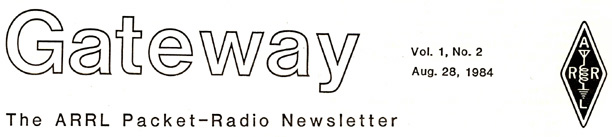
ARRL GATEWAY, Vol. 1, No. 2, August 28, 1984 ~ ARRL Home
On August 23, Curtis Spangler, N6ECT, and Mike Flynn, W2FRT, exchanged packets at 9600 bauds using quadrature amplitude modulation (QAM) techniques. Both stations were using personal computers, 9600-bit/s modems, homemade radio/modem interfaces, and 440-MHz radios. Special software, written in Turbo Pascal, drove the synchronous data link controller (SDLC) cards in the computers. Over the five-mile path between the stations, there were no errors using 10 watts, and 60% to 70% throughput at one watt. Via KA6M
Your Gateway to Packet Radio
by Stan Horzepa, WA1LOU
The American Radio Relay League
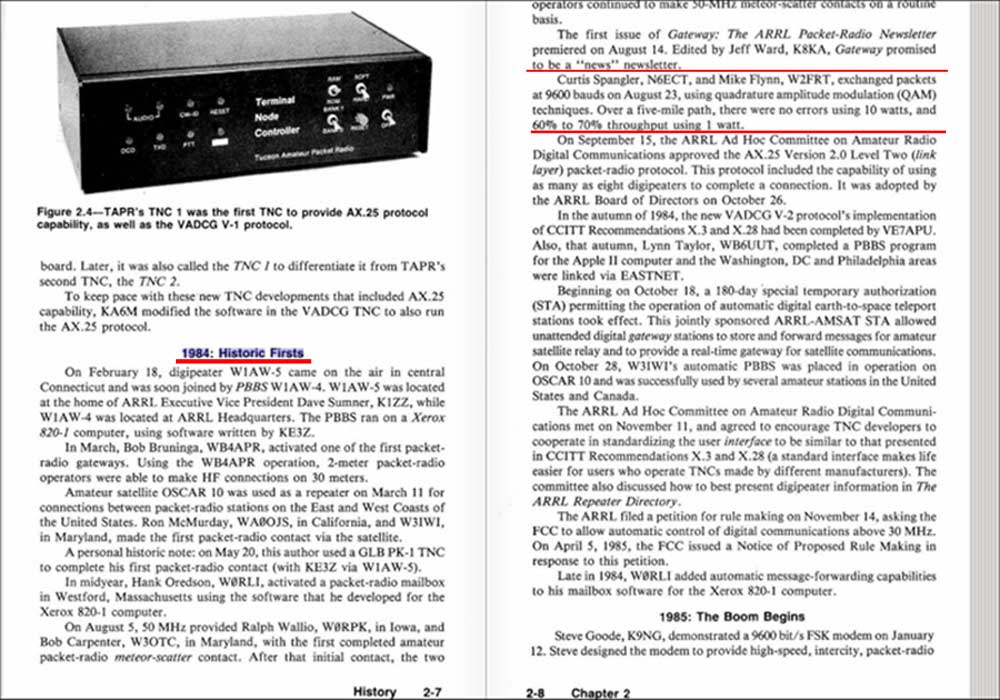
Page 2-8, Chapter 21984: Historic Firsts
Curtis Spangler and Mike Flynn exchanged packets at 9600 bauds on August 23, 1984, using quadrature amplitude modulation (QAM) techniques. Over a five-mile path, there were no errors using 10 watts, and 60% to 70% throughput using one watt.
PPRS - Pacific Packet Radio Society - Historic Wireless Digital Communication
Pacific Packet Radio Society
Wireless Digital Communication was introduced (in the United States) by Dr. Hank Magnuski (Co-founder of PPRS), when his historic KA6M-1 Digital Packet Radio Repeater began operation on:
December 10, 1980
Pacific Packet Radio Society gateway | history | photos | papers | links | packet audio | videoDear Packet Radio Enthusiast,
Thanks very much for the letter of inquiry which you sent me. The response I've received to the initial publicity about the packet repeater has been very enthusiastic, and I have been deluged with requests from hams, both locally and from various points around the country, for more information about the repeater, for schematics, for listings, specifications, modems, proms, SDLC chips, Vancouver boards, and for talks at clubs. Needless to say, all this activity, plus continuing development on the packet hardware and software has kept me very busy, and I apologize for the long delay in responding to your letter. Let me bring you up to date on what has happened, or is happening, since the initial announcement of the repeater, which went on the air in December of 1980.
World's First Digital Repeater for Wireless Data Communications
KA6M/R - Packet Radio Repeater. 1980 ~ Front View ~ PPRS photos
World's First Digital Repeater for Wireless Data Communications
KA6M/R - Packet Radio Repeater, 1980 ~ Back View ~ PPRS photosIn the early months of this year, the packet repeater was operating out of my residence, and was still an experimental machine. Since then, we have installed a couple of upgrades to the control software, we have used a better CPU card, increased the power level, moved the repeater to 700 feet elevation, and integrated its operation to be 100% compatible with the protocol used by the Vancouver Digital Communications Group (VADCG). The repeater has changed from being a laboratory curiosity to a major Bay Area repeater heard from Berkeley to south San Jose, and the user community has grown from a couple of stations to a network of some 30 users. The packet system here now has a mailbox on-line 24 hours a day, several on-line personal computers, and network links (courtesy of a commercial packet network) to the other active packet radio centers in Vancouver and Ottawa. We have also just installed an HF port on 20 Meters, and are beginning some experiments aimed at establishing connection with AMRAD in Washington and with equipment located at W1AW.
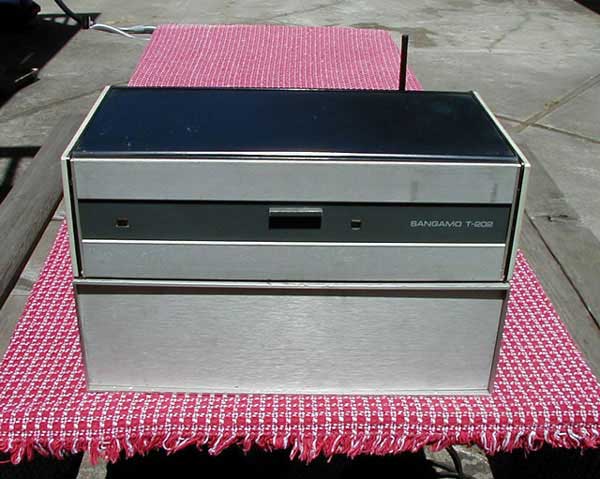
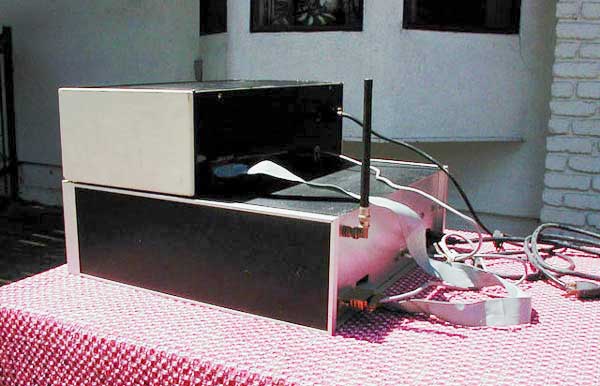
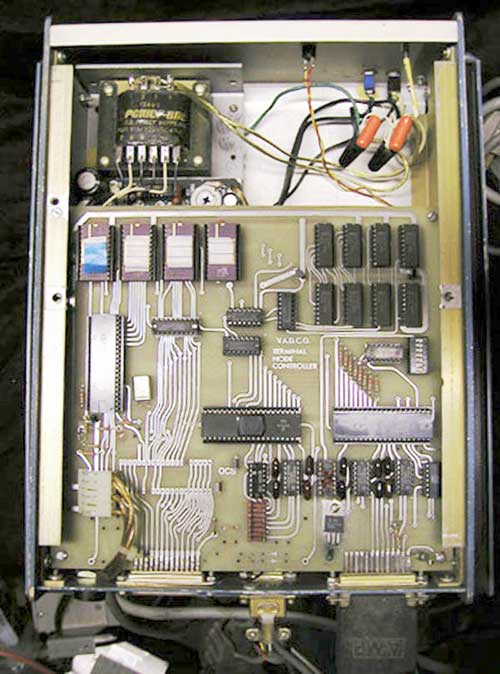
VADCG TNC built by C. Spangler, N6ECT- PPRS photosMost of the original packet radio experiments were done in Canada (in part due to the Canadians' pioneering communications spirit, and in part due to less restrictive regulations up there), and three main centers were at work: Montreal, Ottawa and Vancouver. The technology employed by each of these groups differed, and each approach has its own merits. My thinking and ideas very closely paralleled the work started by Doug Lockhart, VE7APU, and I can best report on what is happening with groups which have adopted HDLC (High-level Data Link Control) framing as the basis of their protocol. The HDLC/ SDLC frame is a new, universally accepted standard in the data communications industry, and Doug and I feel it offers a good starting point on which to build a packet radio network. As it turns out, groups in Washington D.C., Los Angeles, El Paso, Denver, Sacramento, and Hamilton have also taken up this technology, and it is likely that we already have a sufficient number of people using this technique that it will become the defacto standard in the amateur radio community.
It would be impossible for me to completely describe the protocol and equipment being used in this letter, so I will briefly cover some of the topics and give you some pointers on where to find additional information. As you might guess, this is a new area for amateur radio, and tutorial material and handbooks simply do not yet exist. Many issues and problems remain to be discussed, and there is opportunity to make substantial contributions to the state of the art. [Snip] [Continue Reading] - Thanks again for your interest. See you on the net. Best regards, Hank Magnuski, KA6M - [More Papers and History]
Index
Amateur Radio Public Seismic Network - ARPSN
Pacific Packet Radio Society - PPRS - http://www.pprs.org/
