Amateur Radio Public Seismic Network

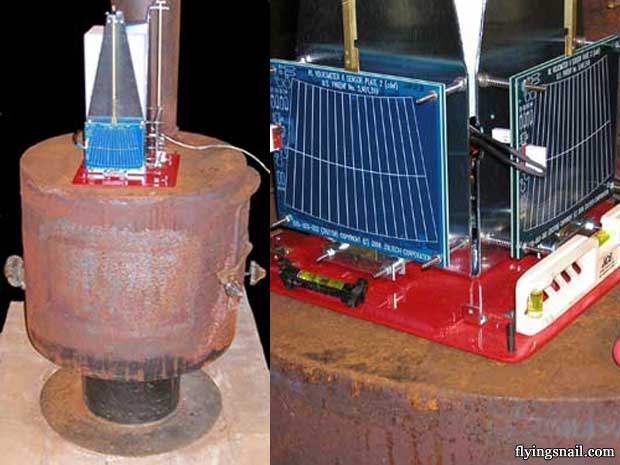
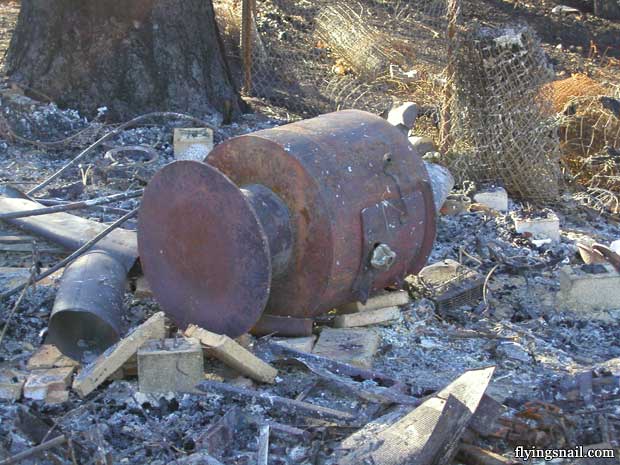
Chang Heng's seismoscope
DeutschspacerEspanolspacerFrancaisspacerItaliano Progress Log PortuguesspacerArabicspacerJapanesespacerKorean

Note: I use JavaScript (located via page source and available) to round picture corners on other pages at this site.

If this picture (Blue Feed Image) does not present itself correctly, part of the JavaScript in your browser is broken. (fwiw) The broken image will now allow one, with broken JavaScript, to see all images, sans rounded corners.

Newer versions of Safari (as of the recent 4.10.11 update, Safari (v 3.1.1 (4525.18)) no longer works and I do not have 10.5, to test Safari under it, yet), Firefox, and MSIE work fine (== What I had available for testing.) ...and... Firefox is a free browser, for most platforms, that will fix this problem.

Text size can increased/decreased using + and - keys, while, on a PC: pressing and holding control key and on a Mac: pressing and holding command (Apple) key.

1st Beacon 30 March 2008 1900 UTC
First APRS Beacon - 30 March 2008

Beacon Location
APRS Beacon Location
http://www.findu.com/cgi-bin/find.cgi?call=N6ECT-1
Via: http://www.findu.com/

1st Observed Motion
It's Alive!-First Observed Motion

Last night handshaking occurred when the following message from the sensor appeared on the laptop: 03/31/08 22:03 DLL: Sending Configure Information

While fine tuning the sensor this morning (200804.01) Input Avg: 0 was achieved.

((fwiw) Obtaining zero was personal choice; taking a little over eight hours. The actual (listed) tolerance is broad (+/- 500 for one sensitivity adjustment and +/-100, +/-50, and +/-10 for other adjustments. My original 'within tolerance' adjustments (+/-38) were completed in 37 minutes; well within the stated +/-50 tolerance.)

With Input Avg: zero and Y-scale set to 100 I watched from a distance for about 39 minutes and decided to make a cup of coffee.

I was amused when my coffee grinder (while grinding) and espresso machine (while steaming) triggered massive seismic events on my laptop screen. (-;

For the fun of it, i cranked up X-scale to one (1) and could could detect the dog and cats walking on the carpeted floor in the hall and living room (two rooms away).

The documentation says the sensor control program is supported for Win XP, 2000, or VISTA. Currently (200804.03) I am looking for a rugged (that will have to live outdoors), used, laptop running XP Pro.

In the meantime, I was able to get the VolksMeter functioning on the serial port (RS232) of an old Win98, Compaq Presario 1685 laptop; rather than the USB port, which (imo) Win98 does not know how to handle.

(200804.03)

N6ECT-1 ARPSN Seismic Data Station 1

Cleaned shed in preparation for permanent ARPSN/APRS operation.

Decided to re-paint the building with lighter color and am considering trying paint that allegedly insulates exterior hot and cold temperatures.

I may also add solar exhaust fans that will not produce noticeable vibration, maybe some new-tech insulation I read about, and the Beacon continues "Off-Duty".

(200804.04)

Garmin etrex H
etrex H

Added picture of Garmin etrex model H, which I normally use when going into deep woods, because it saved me considerable time installing GPS for the VolksMeter.

The first episode occurred while installing the Garmin GPS 16/18, which I call, "GPS hockey puck," into the VolksMeter.

No matter how many times I repositioned the 16/18 (surrounded by tall trees) I could not get a lock (L) on WinSDR (the control program) and this is when I grabbed the etrex.

The etrex located a signal within moments, about 4 feet from the 16/18 and I repositioned it, and saw a lock (L) on the WinSDR screen and a quick check told me I was tracking 6 satellites. I went back to the 16/18 and started moving the etrex around, saw the etrex signal double approximately 2 inches South of the current position of the 16/18 and repositioned it. The computer now showed tracking 9 satellites, and I checked the Enable Location Averaging box to accumulate data.

The second episode occurred while in the process of moving the sensor to its fixed location, where I was able to pinpoint a GPS signal in about 5 minutes with the etrex and position the 16/18.

ARPSN Seismic Data Station Installed and Operational
ARPSN # 1 Operational 04 April 2008 2200 UTC

Installed single N/S sensor and was 'up and running' at 3 PM PDT, April 4th.

ARPSN-1 is currently undergoing a seven day shake-down environmental test in full operational mode.

Everything went smooth today during the 3rd and (for now) final fixed installation of ARPSN-1.

At 10:30 AM, after setting 'everything' up (IA = +/-7) and while standing up to take a break, I lightly bumped the top of the sensor with my elbow; at which point, 'my anal side kicked in'.

Between 10:30 AM and 3 PM, I bumped the sensor, by accident, a total of five (5) times ... and am one of those folks who know, ''once it works, it usually continues to work,' so I started from the beginning each time, doing alignments as close to +/-0. (otoh) The plus side was, I have now memorized a little over half the manual (-;

As mentioned above, the etrex was an asset in setting up the GPS 16/18, which is currently tracking ten (10) positioning satellites.

I have paperwork to get done during the next seven days and if I receive any notable seismic data, during this time, pictures of activity will be placed on an easy access page.

I will post a location teaser on the N6ECT-1 ARPSN beacon, soon.

I am still considering how I will return WinSDR data to the house and will probably run a test using a long ethernet cable I have stashed away, somewhere.

My other alternative is trying a long USB cable to an old XP tower and if that works, get a used XP laptop. (btw) We have cut power usage (here) forty-two percent (42%) by moving from large machines to laptops and Mac Mini computers.

(9:30 pm pdt) Around 6:30 pm I noticed some USGS activity and decided to see if ARPSN-1 recorded any events (activity was close).

When I got there I discovered I must have pushed the display too far down, when I finished at 3 pm, and had shut off the computer off by accident.

On restart, I was pleased to see a IA = +7 and started data collection.

Guess what happened next?

I am tired and when I attempted to stand up, my elbow (for the 6th time) bumped the sensor.

I re-calibrated and was back on-line at 9 pm. [Note to Self: Accept given tolerances rather than anal, 'near zero', self-imposed, tolerances.] (-;

(200804.05)

Checked seismic data collection this morning and event recording is operational. (: Replaced N6ECT-1 "ARPSN Seismic Data Station 1" Beacon with "flyingsnail.com/seismic.html" - seismic.html - Welcome APRS visitors!

(200804.07)

In process of upgrading 1RU to 2RU using a VMII-2CUG (2nd channel upgrade kit).

The kit consists of a pendulum, sensor, and damper assemblies, cables, all hardware necessary to mount assemblies to unused post of 1RU (channel unit).

The kit will allow full North/South/East/West detection with the VolksMeter (ARPSN 1 is currently running one N/S sensor.) and will provide better data reporting for ARPSN [A VMII-2CUG assembly page will be added with pictures.]

I noticed this morning ARPSN 0001 event collection was almost equal to USGS reporting and the 2nd sensor should narrow that. Here is the location of the USGS page I check often:

http://quake.usgs.gov/recenteqs/Quakes/quakes0_fault.htm

and here is an example of where I am considering setting the point (magnitude 3) at which ARPSN issues an alert (in my area) via the APRS network:

http://quake.usgs.gov/recenteqs/Quakes/quakes.big_fault.htm **

(200804.09) I noticed the D700A shut itself off yesterday afternoon, and it is on an APC UPS, which did not indicate a 'power out'. I have read about these shutdowns and pressing the power button restored operation (this morning).

I changed the N6ECT-1 beacon to ARPSN-1 Seismic Alert System and will start broadcasting magnitude 3, or above, seismic activity; (imo) a small amount of activity, which is presented in this link **

ARPSN-1 is a "fixed station" running WIDE2-2 - PACKET PATH and my intention is to beacon once per 24 hours; unless there is 3 Magnitude, or greater, seismic activity, based on the following information:

Fix #6, Proportional Pathing for Trackers:

The original APRS design uses a Decaying Algorithm to send new data more frequently than old data, and make each later copy less and less often if the packet is unchanging. Most follow-on APRS clones, and trackers ignored this fundamental principal and transmit far too much duplicate unchanging info. . We need trackers to use direct and local 1 hop paths more often than 2 or 3-hop paths. . I call this Proportional Pathing

http://web.usna.navy.mil/~bruninga/aprs/fix14439.html

Another thing I would like to implement in ARPSN, for reporting purposes, is something mentioned by Bob Bruninga, WB4APR:

APRS Common Bulletin Board for Situational Awareness
16 Jan 2008 - WB4APR

http://web.usna.navy.mil/~bruninga/aprs/bulletinBoard.txt

I have been reading too much and my right eye is starting to blur again, so I will attempt to divert my attention elsewhere, which brings me to today's project, 'isolating ARPSN-1's main sensor'.

If all goes as expected, I will be able to return the laptop, from the seismic shed to, the house, and have resurrected an old XP PRO tower, that will serve as ARPSN 'back-up', but we will see... and I will report later. (fwiw) This move, if successful, will allow me to begin uploading seismic images and data to the seismic page.

Finally, if one emits APRS traffic in Northern California, (imo) this is a good site to check, frequently:

http://www.norcalaprs.net/usagex.html

(200804.10)

N6ECT-1,ARPSN-1 under test

Yesterday I was able to move ARPSN-1's laptop to my main computer room with (imo) great success.

The first thing I did was review collected seismic data and was impressed by the number of recorded events.

It took about four hours to compare my results with USGS and ;-) I am feeling more confident.

(fwiw) During my past forty year interest in amateur seismology I have not paid much attention to teleseismic events, because I have been more interested in local activity.

For testing purposes, I "Enabled" (with supplied settings) "Teleseismic Event Detection", with ADC Bits: 24, SPS: 10, and was amused when I discovered one of the events recorded was this one:

Magnitude 7.3 - LOYALTY ISLANDS
http://earthquake.usgs.gov/eqcenter/recenteqsww/Quakes/us2008qqa2.php#details

Another thing I noticed was 'software tuning' of the sensor improved greatly with the laptop now considerable distance away from the 1RU.

Currently I'm testing ADC Bits: 20, SPS: 20.

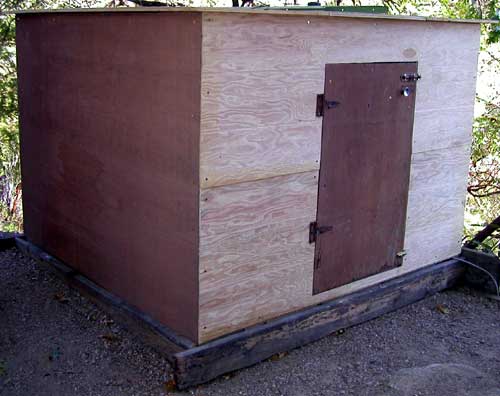
When I install the E/W sensor, I may rebuild the seismic shed, because I feel it may be to tall and catches wind blowing up from the canyon below. As it stands, it is seven feet, five inches tall and my idea is to make it four feet tall and insulate it.

Although I detected the magnitude 3.8 event in Petrolia, California, at 7:17:34 this morning, I did not broadcast it via APRS, because I was not prepared and, to be honest, am more into verification than reporting, at this point.

Finally, I am adding a RSS feed for this page, so those who use feeds will know when I have added something new. In elder days I used Un*x "finger", but Nobody seems to use that anymore (-;

(200804.12)

FFT display of the M 5.2 Off the coast of Oregon

The above image is a FFT display of the M 5.2 Off the coast of Oregon (received N/S) and here are the details:

http://earthquake.usgs.gov/eqcenter/recenteqsww/Quakes/us2008qtbd.php

More later == dealing with Windows 98 MFC42.DLL problem that had nothing to do with operation of the VolksMeter II or WinQuake/WinSDR software. I fixed it and am defragging the disk as I type.

(200804.13)

A catch-up on what happened yesterday and a Windows 98 MFC42.DLL fix that worked for me:

I ASSUME, while using Start -> Settings -> Control Panel -> Add/Remove Programs, to clean up 'unused' programs (freeing disk space), one of the Uninstall programs removed MFC42.DLL from C:\WINDOWS\SYSTEM\.

Using, Start -> Find -> Files or Folders -> Named -> MFC42.DLL, and my main disk drive, I 'right clicked' each MFC42.DLL file found and Renamed it MFC42.old (If you have MFC42.DLL in C:\WINDOWS\SYSTEM\, leave it alone, and see if the problem goes away after a restart. (fwiw) I did NOT have MFC42.DLL on my drive.).

I replaced the missing C:\WINDOWS\SYSTEM\MFC42.DLL with one located on my '98 Second Edition Updates' disc at: E:\drivers\audio\aureal (there is another MFC42.DLL located at: E:\add-ons\pws), rebooted, and everything was back 'to normal'.

I spent the first three hours yesterday morning verifying recorded events (since the last time I cleared 'event number') and finished verifying recent 'Saved Events' with USGS. Every event had a match and if I can ;-) resist changing voltages and samples (-; I will post a Channel One (N/S) image.

I also seem to be 'cramming' a lot of teleseismic information because it is both new and fascinating, thanks to my adventure with the VolksMeter.

(200804.14)

ARPSN-1 VolksMeter 1RU - CH1 display 200804.14

WinSDR 20080414 screenshot
Screenshot of current WinSDR window 200804.14

Added screenshot of ARPSN-1 Channel One Display (click image for larger picture) and added screenshot of how I am currently using WinSDR.

Today I am cleaning up my electronics workbench in preparation for the arrival of the E/W sensor.

(200804.15)

VolksMeter 2CUG kit

The 2CUG kit arrived yesterday and assembly will begin as soon as it warms up here. The current temperature is 36.9F degrees or 2.7C on the front porch and 34F outside.

Last night we had some strong wind and I noticed it had an effect on the VolksMeter II.

After observing weather conditions on the effect of the VMII sensor in the seismic shed, I have decided to rebuild part of the shed to take it off the concrete slab, where is is currently fixed/attached, and causes excess vibration when strong wind blows. Here is my new idea:

New plan for seiswmic shed

Also, I will be adding a weather station for Seismic Station reference and will eventually connect it to the APRS network.

(200804.16)

Assembling VolksMeter II - 2CUG Kit
"And I did it my way"
- Sid Vicious
2CUG Kit Highlighted - Tools are part of the original 1RU
2CUG Kit Highlighted - Tools part of original 1RU

Final Test Alignment

(200804.17)

Screenshot 2 Channels working X4/Y100 - 2RU Ready for Permanent Install
VolksMeter II - 2RU Ready for Permanent Install

Completed assembly of 2CUG Kit and ready for permanent install. Pictures and notes located at:

http://www.flyingsnail.com/AmateurRadio/assm2cug.html

I am currently deciding what to do about the seismic shed.

(fwiw) Adding a second sensor was easy and if I had it to do over again, I would have ordered the 2RU first because I got snagged on LFEs (Low-Frequency Earthquakes) and Teleseismic Events, which I will report on later.

P.S. The last time I had this much fun was twenty-eight (28) years ago, when I was involved with the Pacific Packet Radio Society - PPRS !!!

2RU on Wood Stove

(Trivia) The 2RU is sitting on a level wood stove (in the studio) that is made out of injection tubing & plate, and has it's own foundation.

I've had the 2RU apart numerous times, have reset everything for the best possible signal receive, and am currently looking for low-frequency activity. (Low-Frequency Earthquakes (LFE) is a fascinating subject that may lead to an 'early earthquake detection/warning system'.)

I am impressed with the 2RU's performance and intend to install it (in the shed) tomorrow; despite wind, because the shed needs more consideration.

I am also considering moving ARPSN to a geophone (covers local events) and establish the new sensor as my original PSN concept.

(200804.20)

On Friday, 200804.18, VMII-2RU was installed in the (non-modified) seismic shed.

If one is curious why the shed was not modified before the install, a simple answer is, 'anxious anticipation of data retrieval' and the complex answer is, 'LFE/teleseismic activity observed in the hours leading up to the install,' which enhanced my new 'LFE wrinkle' (wrinkle = fascination with 2RU's teleseismic/LFE capabilities) and here is what that means (imo).

The VolksMeter is more handy (to me) as a research tool, rather than being put into Amateur Radio service to cover local earthquake events; however, all sensor data (collected here) will be eventually provided on Flying Snail's PSN page (seismic.html).

Within the next few weeks, I will install a Mark Products 4.5 Hz 3 Component L15B Sensor, which will be incorporated into ARPSN-1, for LOCAL EVENTS. Below is a data sheet with pictures:

Mark Products 4.5 Hz 3 Component L15B Sensor

In order to provide more accurate results, installing a weather station has been added to the 'to-do' list, and will be incorporated into N6ECT-1/ARPSN-1.

A weather station will be used to monitor/measure environmental conditions surrounding the seismic shed, with an inside (shed) temperature monitor.

During most of the weekend I have been evaluating, analyzing, and comparing seismic data. Here are some recent 'snaps', first image = North/South sensor and second image = East/West sensor:

Channel 3 - ADC: 16v - SPS: 80

Start: 04/19/08 - VolksMeter II 2RU Velocity [Integrated] Data Channel 1 - N/S
04/19/08 - VolksMeter Velocity [Integrated] Data Channel 1 - N/S - Large Image

Channel 4 - ADC: 16v - SPS: 80

Start: 04/19/08 - VolksMeter II 2RU Velocity [Integrated] Data Channel 2 - E/W
04/19/08 - VolksMeter Velocity [Integrated] Data Channel 2 - E/W - Large Image

I will eventually change the way data is displayed on the twenty-four (24) hour charts and include CH1/CH2 Accelerated images. I selected the above display format to allow for easier cross reference verification with 'outside sources'.

Honestly speaking, at this point (imo), the VolksMeter will require about three months of testing before being placed in 'active service'; whereas, the ARPSN-1 L15B sensor will take less than a month.

I have alternative seismic systems (currently operating) that may, temporarily, be placed in service for ARPSN-1, but have not decided, yet.

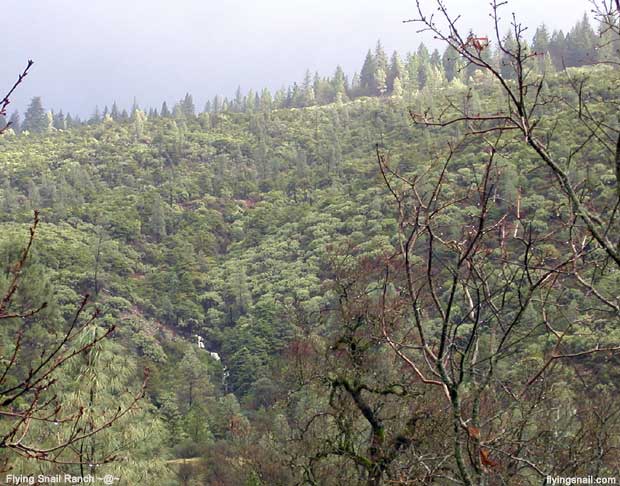
Finally, some may be interested in our local terrain, which sits in a highly seismic area:

Kitchen Window, Rainbow in canyon below.

Images located at:

http://flyingsnail.com/Garden2003/index.html

http://flyingsnail.com/firewatch.html

(200804.23)

There are some things that need seriously to be clarified concerning theory of seismometers, since there is so much confusion; not only among amateur seismologists, but also even many professional geoscientists.

Ultimately, the ONLY source of seismograph excitation (no matter the instrument design) is ENERGY. Additionally, the ONLY thing that delivers energy to the seismometer is Earth's ACCELERATION at the site of the instrument. This is true not only for the instrument's response to earthquake waves whose periods are shorter than about 300 s, but also for earth 'hum' in which the instrument responds mainly to tilt, when the periods are greater than about 300 to 1000 s. Dr. Randall D. Peters - Department of Physics, Mercer University, Macon, Georgia.

I have been immersed in the writings of Randall D. Peters and have attempted to devour every word ;-) especially his 'debunking material (-; (which I can relate to). Excellent reading, and if one is curious about my direction with the VolksMeter, this is the place to browse. - http://physics.mercer.edu/

The below (green) was written yesterday (200804.22) before I updated WinSDR from v4.1.2 to v4.1.4 and lost 'all' of my event files. (fwiw) The majority of my computer experience is based on Unix, I tend to get "\" and "/" confused under Windows, and it was my error that caused the data loss.

As I sit here, I can look over my shoulder at the last hour of recorded seismic activity and can match major activity, here, with everything listed at USGS:

http://earthquake.usgs.gov/eqcenter/recenteqsww/Quakes/quakes_all.html

and have a great (imo) FFT of the M-5.9 located off the East coast of Honshu, Japan (I am currently running ADC: 20, SPS: 25), which I may post tomorrow.

For those monitoring N6ECT-1/ARPSN-1 (APRS), I have decided to 'up the Magnitude' to: '4 and above' (local), for the moment, and will explain later. All I need to do is connect a cable, and my data will start uploading, but I still have some things to 'work out', before that happens.

I have decided to create a special housing for the VolksMeter in order to allow for its 'full potential and am not in a hurry (current data keeps me 'into the screen' and taking notes).

If it warms up, and all goes well, I should have the L15Bs' on-line this weekend and (perhaps), start APRS alerts.

(200804.24)

L15B - A/D & Amp. Filter - L15B

Mark Products L15Bs with A/D and Amp/Filter by Lar ry Cochrane in box

Mark Products L15Bs', etc., ready for install, tomorrow, if the weather warms up, and these are the sensors intended for LOCAL seismic APRS alerts.

(200804.28)

L15B Heliplot
Mark Products 4.5Hz L15B Sensor North/South Acceleration - SPS: 50 - Updating image

L15B heliplots available here: http://www.flyingsnail.com/seismic.html

(200804.30)

Northern California APRS Traffic 200804.29
[Click for larger image]

The above is a screenshot of Northern California APRS traffic at around 9 pm pdt 200804.29.

It was produced by a free APRS Windows program titled: UI-View16 (There is an UI-View32 APRS client available.) and you can read about it here:

http://www.ui-view.org/

(200805.01)

On the 25th of April I was diverted by a 'wrinkle in the system', worked until yesterday to resolve it, and the only thing I regret is not being able to 'launch a beacon' for the M 5.2 earthquake in Willow Creek, CA, near Eureka.

All sensors are working fine and the only thing I need to do is get the L15Bs off network time and on their own gps.

The VolksMeter is running at a new location and is collecting 'lots of data", which keeps me busy. Eventually I will put images up, but am doing what I call 'fine tuning' ...at the moment, and will eventually get around to pictures.

Yesterday marked the 30th day of this project and I need a day off (-;

(200805.05)

Davis 6152c (cabled) Weather Station

Adding Davis 6152c (cabled) Weather Station to N6ECT-?/ARPSN-1 (an aid for 'fine tuning', to associate with seismic data) and pictures will be added under a 'future', to be constructed, weather page.

The Davis was selected because of accessories and ease of upgrading. In due process, I will include a section on building a home-made weather station.

I have not decided on which software I will use and that will be added later.

I managed to get the L15B package (the main sensors for ARPSN) functioning with the Garmin GPS and images are currently being uploaded to the seismic page.

(fwiw) Uploading data (for me, at this point) is a PITA because we use secure access (ssh/sftp) and most Windows software does not address this. In turn, I (for personal reasons) upload all pertinent Windows data into an 'iron box', that scans input/output/etc. for 'nasties', and then sends checked data to a machine that uploads it securely, to my pages. Yes, there is (what I call) 'work-around software', which establishes a sftp shell, but rarely comes with source, and I don't have time to 'monitor it'.

(200805.07)

Highlighted area = large trace due to wind noise

The highlighted area, in the above image, is a good example of why a weather station is being included in the ARPSN project and will explain part of my concept of 'fine tuning' in regard to seismic stations.

The large traces above; including the highlighted area, are due to wind noise (very strong wind on the seismic shed, which is still bolted to the concrete slab) and a weather station will help me properly insulate wind noise in the new shed, which I am now considering changing from wood to filled concrete block (think bunker).

Today, around 02:30 AM PDT (green line in above image), there was a BSOD (Blue Screen of Death) on the computer running ARPSN-1 (L15B package); after 12 days of error free operation since installation, and here is what happened leading up to Microsoft's error message:

If you recall (written above 200804.13) I had an incident with Windows 98 MFC42.DLL, was 'being nice' when I explained it, and the reason I am bringing it up again, is because I turned Microsoft's Automatic Updating OFF on both machines, when that happened.

Yesterday, I noticed there was a XP update (SP3), clicked Install, clicked Accept, and the download began.

It consumed about an hour of downloading time and produced an error which told me to check 'software download history' to discover why the error happened == and there was NO explanation as to why the error occurred, there.

I closed MSIE on the software update history page and clicked "Windows Update" again, only to have the same thing happen; which, in total, repeated the same error three times. I gave up and went to bed.

When I got up this morning, a BSOD was on my screen, and a weird boot screen when it started, so I restarted Win XP PRO and WinSDR again, with hopes this does not happen again. (fwiw) This machine was/is only allowed on the Internet to collect Microsoft updates, was originally intended as a 'game machine', until I switched to a PS-2, and worked great until the first SP1 update, at which point, most of my games stopped working and I had to reload the original XP discs to get them back.

When XP SP2 was announced, I waited for six months to see what was being said about the update before I tried it myself, and after installing it, the games still worked; however, a chunk of RAM disappeared, even though the RAM and MB (swapped) check out fine, so I retired the machine and it was moved into storage for a future project.

I brought the 'game machine' back into service (for the VolksMeter) with a fresh XP software install up to and including SP2, with all current updates, and noticed the missing memory returned. So, without incident, I've used this machine with SP2, for around a month, with no problems

After this mornings error incident with BSOD, I attempted another SP3 update, it presented me with a new 'acceptance window', which I accepted, and it started the 66+ MB download again, consumed about x? hours downloading time, and the current images, on the seismic page, were created under it.

((fwiw) There is NO high speed Internet (here) in our small populated (12 families), AT&T based, rural area; however, 3 miles North or 5 miles South, where the population is over one thousand, there is high speed access... and (fwiw), because of trees, which I will NOT cut down and winter weather, satellite does not work well here, ...and don't get me started because I worked with Nick Marshall, W6OLO, for four years (Starquest). ...and Nobody wants "historic" QAM experiments allowing for advanced remote control brought up (-;)

11:00 AM PDT - Just to be fair, I took ARPSN seismic data collection off-line (for a while), looked around, a bit, at the 'new stuff', checked to see if any new updates had been listed on the update page (none), verified SP3 had indeed, been loaded (yes), rebooted the machine, missing RAM was back, uploaded recent seismic activity, wind is slowing down, and 'noise' on the gifs is reducing.

It looks as if 'things' may have gone back to "normal"; a term Nobody wants to define (-;

(200805.12)

The Vantage Pro2 is ready for outside installation (maybe tomorrow) and N6ECT-2/ARPSN-1 WX (weather) data could be available by this weekend, ...if all goes as planned.

I decided to use "WeatherLink" APRS software (6540) with the Davis VP2 and information about it will be added to the 'upcoming' weather page.

(200805.13)

Davis Advantage Pro2 operational

Davis Vantage Pro2 operational and software will be installed soon (I found a 12 volt PC with 6 serial ports I am exploring).

(200805.15)

22 MPH Wind Noise

The above image reflects '22 MPH wind' and 'no wind' on the seismic shed and will be used to compare new shed vs. old.

I have not installed WeatherLink software or APRS WX yet, because I am waiting for some parts.

I anticipate the start of construction on a new seismic shed, sans wind noise, this weekend, believe it is fair to give a little more background, at this point. This is something re-published 20 June 1981 on the construction of a magnetic table, in another area of interest (It is in image form because I have not had time to OCR it).

http://www.flyingsnail.com/missingbbs/ct48.html

and of special interest (to me) was the comment, second paragraph from the bottom, that I am considering in regard to noise reduction for the shed frame and will explain later. This is the index for the above page:

http://www.flyingsnail.com/missingbbs/CommuniTree.html

(200805.19)

Equipment I was expecting to show up on Friday never arrived, outside temperature was in the 100s over the weekend, the computer room, due to the towers I moved in for the sensors and WX station, was 102f degrees, and little was completed over the weekend.

If the equipment I am waiting for arrives today, and it is before it gets too hot, ARPSN will shut down for a short period of time while upgrades are incorporated; including installation of WeatherLink APRS.

I tried an experiment with the Davis VP2, hooked up to a Mac G4 tower running 10.3.9, with a Keyspan Serial to USB adapter using WeatherTracker Beta. The beta software had expired and I did not have time to download it again (dial-up was very slow). You can read about WeatherTracker here:

http://www.afterten.com/products/weathertracker/index.html

For 'all practical purposes' ARPSN is almost finished; from a model point of view, and what remains are (imo) 'rough edges', with seismic shed rebuild being number 1 and the paperwork number 2.

(fwiw/repeat) What is manifesting here is actually model construction, which will be used to reconstruct everything mentioned (here) using low-cost 'home-brew' methods. For example, in regard to a WX Station:

TAPR T-238+MODEM2 Kit - A Low-Cost APRS WeatherStation
http://www.tapr.org/kits_t238plus.html

Tecnologia Aplicada 1-Wire Weather Station
http://www.aagelectronica.com/aag/index.html

Weather Software Supporting CWOP/APRSWXNET Protocol
http://home.comcast.net/~dshelms/cwop.html

Rabbit Powered 1-Wire Weather Station Controller
http://www.lightningnetwork.org/rabbitweather/

XastirWIKI
http://www.xastir.org/wiki/index.php
[XASTIR is FREE for Mac OS X, freeBSD, Linux variants, Solaris, Windows, etc.]

(200805.20)

Part of the 'stuff' I was waiting for arrived late yesterday afternoon, so I spent the rest of the day and early this morning getting 'another part' of ARPSN completed.

I am still waiting for another piece of equipment to arrive that 'should' tie everything together ...then, there is still 'the shed'.

Recently I posted the following to a group, received a response, and am placing it here as an aid for anyone else with the same ;-) anal (-; need for verification.

On or around February 29, 2008, Kenwood provided an update for the D710A that stated:

Updated items : (Version 1.00 1.01) [February 29, 2008]

Updates the following feature.

Works with the data logger of the "WeatherLink® for APRS, with Streaming Data Logger" (Davis Part No. 06540) [which i have] as well as the data logger of the "WeatherLink® for Vantage Pro2™, Windows, Serial Port" (Davis Part No. 06510SER).

Note : Please set the "BAUD RATE" (Menu No.602) to 9600bps for stable working performance."

https://www.kenwood.com/i/products/info/amateur/tmd710_tnc_update_e.html

I understood the above to mean I can plug the Davis "Data Logger" into the D710A serial port, supply transmit parameters, and WeatherLink will supply the WX stream. ??? Is that correct?

Verification appreciated.

Response:

Yes.

See this link:

http://www.davisnet.com/weather/products/weather_product.asp?pnum=06540

Also see page 29 of the new In-Depth Kenwood Manual for the D710, written by Bob Bruniga:

http://www.kenwood.com/i/products/info/amateur/pdf/TM-D710AE_IDM_R1.pdf

Snips pertaining to my interest from the above PDF:

6.2.1.1 Davis Instruments Corp.

"The weather station, Vantage Pro2 from Davis Instruments can be used with TM-D710A/E or RC-D710."

"WeatherLink for APRS With Streaming Data Logger [There is a sticker on my box that says the previous.] (Davis Part #.06540) is required for TM-D710A/E and RC-D710."

tnx simmoh56

(200805.21)

Screenshot of WeatherLink and L15Bs running on same machine
Click for larger image

The equipment part (I needed two weeks ago and not the fault of the company.) arrived early this afternoon and I have been busy; but first, a comment on our recent local weather.

If you recall, due to the 100+ f. degree temperatures (here) last weekend, the seismic shed rebuild got postponed, and the hot temperatures continued; except during the evening, when it cools down on the mountain.

Yesterday it was in the 100s f. again and this morning it was in the 40s f. at the house (upper 30s at the NW corner == not 'normal weather') and currently (0321 UTC) is 56 f. degrees.

[This radical change in temperature reminded me of a place I visited in the Himalayas, where it would be +/- zero during the night and 80 +/- f. degrees during the day.]

Because I am tired, this will be a brief 'catch-up' [more pictures or a new page later].

A used (lease expired) HP/COMPAQ NC6000 - XP-PRO/SP3 laptop (with port replicator) was added to ARPSN-1 along with a QUATECH RS-232, 4 Port PCMCIA Type II card (Part # QSP-100 G) and I have the Davis VP2 running WeatherLink for APRS and the MP L15Bs running on two serial ports of it (QSP-100). The VolksMeter sensors also work on it, and the remaining thing I need to test is the serial connection to the Kenwood D700A with the Kenwood software (tomorrow). The D710A will be discussed later.

I am pleased with WeatherLink and will eventually begin to set up a weather page, associated programs, and feeds.

(fwiw) I put a week's worth of research into the four port serial Quatech PCMCIA (with port replicator total = five (5) RS-232 ports) and my main reason for selecting this device; besides the fact it appears 'to work out of the box as stated,' is because I discovered an Express Card to PCMCIA card converter that will work with newer laptops, in case I want to upgrade to a newer notebook with ample storage, on alternative power.

Proposed and working = ** :

Serial Port #:

1 = free **

2 = L15Bs **

3 = WeatherLink **

4 = VolksMeter (** yes, but no data provided until seismic shed rebuild)

5 = Tm-D700A (untested)

To Be Continued == gn

(200805.22)

Everything (electronic) is still working, I spent most of the day digging a new seismic shed foundation, and got about one quarter (1/4) done.

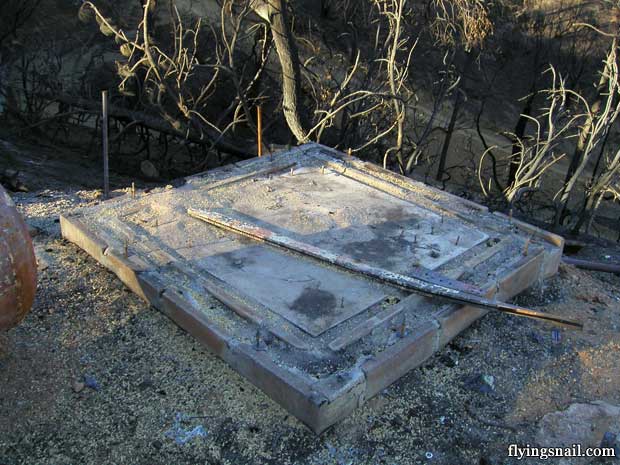
The slab was originally poured on a large rock and I am using a chisel to remove packed earth, about a foot from the slab, on four sides (for the concrete block foundation) ... and, there will be pictures.

(200805.26)

New seismic shed foundation

I decided to stick with the original seismic shed plan (above) for the first test and if that does not work, I will move to plan two and build a concrete bunker.

I worked every day (during the holiday) on the new foundation and it was slow. I ended up using a chisel and hammer (pictured) to dig out the trench, which is still not finished, yet.

I let the sensors run while digging the trench, observed only a little sensor noise, and now feel the new shed may clean up the 'wind noise' problem.

When the foundation is complete, I will unbolt the old shed from the slab, re-do it using more insulation and reinforcement, and then bolt it to the new foundation.

All electronics continue to work fine.

(200805.30)

As usual, things are taking longer than expected, the rebuild of the seismic shed is tending towards PITA, and having a younger body would be an asset (-;

Last night, around 7 pm, I finished the foundation trench on the 'cliff side' and to complete that portion, I still have to level the trench, tie the concrete blocks together, and pour the concrete (maybe today).

I had hoped to be finished with ARPSN by today, the sixtieth (60) day of this project, am glad I allocated an extra 30 days for the delivery delays, etc., and wanted to say, Thank you for visiting.

Weather and Seismic Activity, Cobb [Mountain], California, USA

Click above image for large picture. Top is local weather, bottom is concurrent seismic activity; UTC time noted on left, GPS date, UTC, PDT time is located in the lower left corner. - Updating Image corresponds to seismic page image.

(200806.04)

I am still working on the seismic shed and have been distracted by the weather.

If one has been looking at ARPSN heliplots or weather charts, the wind is obvious, and this is not 'windy season', which usually happens during the Winter.

There are three things that are observed here when it is windy:

1) 'Widow Makers' - broken branches caught in trees, that blow down without warning.

2) Pine Cones - Digger Pine trees, most over 100 feet tall, having enormous pine cones that blow down.

3) FIRE WATCH - http://flyingsnail.com/firewatch.html - the wind dries 'things' out very quickly and makes us 'edgy'.

Currently, we have had about a week of wind (very dry), our Winter spring has stopped (2 months early), our Summer spring (gravity flow) is down to 25 PSI (stones in the system that have to be cleaned), the rattlesnakes are coming down the mountain a month early (headed for the streams below), and the meadows have not been cleared, yet, bringing new meaning to 'snake in the grass' (-;

On or around 30 December 2007, I created a page titled, "Our Local Global Warming, How Global Warming Is Currently Affecting Us" which will add more information and pictures, if one is interested.

I am working on 'Fire Watch' now and cleaning up as much of the property as I can, about 1000 feet around the house...and (fwiw) we had less than forty (40) inches of rain this year; a new low.

The seismic shed foundation has been leveled, the blocks are in place, and I am having a hard time locating my 'rebar stash', which I need to tie the blocks together.

(200806.06)

Progress continues.

I increased the depth of the trench (for the foundation) by six inches; in case I want to pursue the 'bunker idea'' later, and will get into why it took longer than expected later (hint: roots).

I located the rebar and other material for block 'tie down' and am looking for a 'long bolt' stash I had tucked away for attaching the wood frame.

I have gone through considerable debate about approach; something I will get into later, and have continued to stick with original plan number one; just to see if my projections yield better results.

I'm tired, my body aches, so it must have been a good day. Pictures tomorrow, maybe.

(200806.10)

This note is to call attention to extra packets the D700A is transmitting.

Currently, I manually transmit one N6ECT-1 beacon every +/- twenty-four (24) hours.

On four occasions, the D700A has transmitted a second packet, by itself, and today I was able to observe it happen.

Eventually I will replace the D700A with a D710A to see if the same result is observed.

The Seismic Shed is still being worked on. I have been hand cutting (I broke all the metal power saw blades.) through tempered metal (1/4 inch per hour) and have one piece to cut and that part is done.

8:37 PM - Metal work complete and all that remains 'of this part' is the concrete and sand. gn

(200806.18)

Near the end of last week we lost our main water feed to the house; which is also used for irrigation, leaving us with about 1400 gallons of water in 'the drinking' tank. Today, it is down to about 200 gallons and bathing in the (spring fed) pond is too cold (-;

I have worked every day on restoring the water; with exception of one day when I injured my hand, and it is still not complete. (fwiw) When I was in my 40s through 50s, the work (here) was easier, but now, the elder aspect of age is pissing me off (-; because I am still on that 16/7 work schedule and getting less done.

Since I have mentioned weather changes in our area before, here is something that gets 'more in depth' from the local paper:

Dry weather, spring freeze cost local farmers millions

Estimated Lake County spring crop losses
Pears: $12,108,656
Winegrapes: $3,028,894
Hay crop: $1,600,000
Walnuts: $1,026,998
Rangeland: $138,240
Total: $17,902,788
Lake County Agricultural Commissioner's Office figures

http://lakeconews.com/content/view/4599/764/

When water is restored I will return to the 'last phases' of the new seismic shed.

(200806.21)

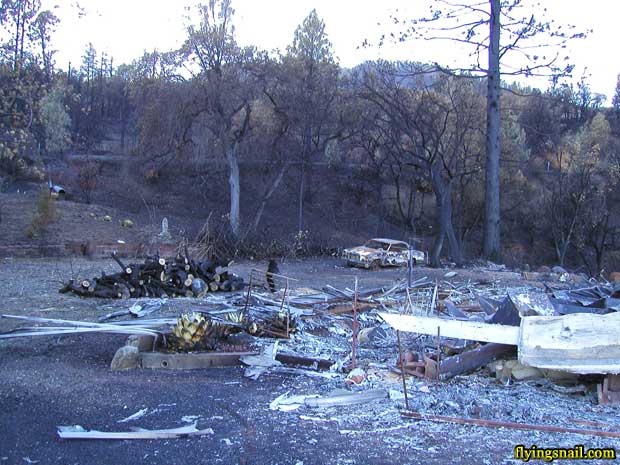
200806.21 Northern California Fire Smoke at Flying Snail

The above photo is my latest excuse for not working on the seismic shed and represents what some of the smoke from all Northern California fires looks like here (much thicker when the wind stops) and due to health problems, I have to remain inside until the smoke clears.

(200807.08)

No ARPSN progress due to smoke from Northern California fires. (fwiw) The smoke leaves a very fine ash on everything and messes up our county record of having the cleanest air in any California county.

If you would like to see a current Google Map of the fires in our area Click Here.

D700A Report - Besides the small amount of unauthorized packet transmission, I have noticed 3 cases where the power on the D700A has changed 2 times to H (high power) and 1 time to M (medium power) by itself. (fwiw) Once set (back in March) the radio has not been touched; except, to restore original settings I made.

Finally, it was 105.7 f. in the computer room yesterday (the first vent from the air conditioner comes into the computer room and sucks in the smoke, so we had to turn it off.) which makes it difficult to do anything.

Unless something new occurs, this will be the last post here for a while, until the Shed is complete.

200807.10 - 9 AM PDT Smoke


[Valid RSS] SpacerValid CSS!Spacer Valid XHTML 1.0 Transitional SpacerLink to FlyingSnail.com/Podcast/index.html